Showing posts with label weaponize the arctic. Show all posts

Thursday, October 22, 2015

Russia's defense min has built a giant military base “Arctic trefoil” in the far northern Arctic.

Source 

Russia's defense min has built a giant military base “Arctic trefoil” in the far northern Arctic.(rferl).

Russia's defense ministry said it has built a giant military base in the far northern Arctic, establishing a sprawling presence where Russia hopes to retrieve oil and other mineral riches.

The ministry said October 20 that the building erected on the large island of Alexandra Land, which is part of the Franz Josef Land archipelago, is 97 percent complete.

Named the "Arctic Trefoil," or three-lobed leaf, the massive three-pointed structure is colored red, white, and blue like the Russian flag. It is a permanent structure located on the 80th parallel north and has an area of over 14,000 square meters.

Russia is building up its Arctic military infrastructure as part of a recently updated Naval Doctrine, which proclaims the region as a top priority due to its mineral riches and strategic importance.

Russia has already built a similar military base called the "Northern Shamrock" on Kotelny island in the East Siberian Sea further south on the 75th parallel.
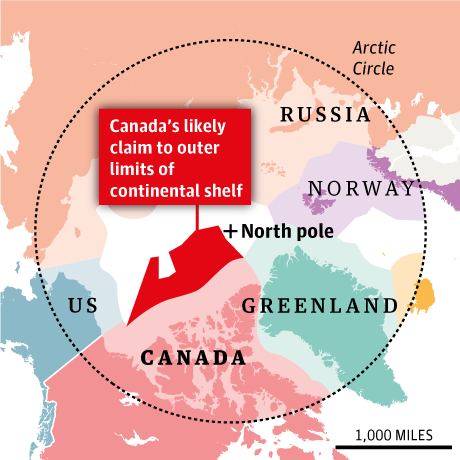


Russia has increasingly asserted itself as an Arctic nation. This year, it filed a United Nations claim for a vast swathe of the region including the North Pole, and it has been holding wargames in the area.

Parts of the same area are claimed by Canada, Norway, and the United States, among other Arctic nations.

The new Arctic Trefoil structure can house 150 soldiers and stock enough fuel and food to let them work and live there independently for a year and a half, the ministry said.


The soldiers can move around the base from one building to another without going outside to face winter temperatures which can reach minus 47 degrees Celsius (-57 degrees Fahrenheit). Roads have been built and fuel can be pumped in from tankers.

"No one has implemented similar projects at such a high latitude until now," said Northern Fleet Commander Admiral Vladimir Korolyov, adding that "the air defense units on combat duty in Russia's northernmost point are combat-ready and capable of performing their assigned missions." Hmmmm.....With Justine leading Canada now the Russians are safe. Read the full story here.

Friday, October 2, 2015

Russia Will Defend Its Right to Arctic Oil, Gas With Missiles.


Russia Will Defend Its Right to Arctic Oil, Gas With Missiles.(SP).

All necessary infrastructure for stationing air defense troops is currently being built on Sredny Island in the Kara Sea, Die Welt wrote.

“Around 1,500 workers have been hired to build such military facilities on six islands in the Arctic,” the newspaper added.

Putin Calls for Balance Between Arctic Resources' Extraction and Ecosystem As a major player in the global energy market, Russia is trying to gain access to sections on the Arctic Ocean shelf with a forecast hydrocarbon resource totaling 4.9 billion tons of oil equivalent.

The Arctic is believed to hold up to 25 percent of the planet's untapped oil and gas supplies, and Russia, the US, Canada, Denmark and Norway have all been trying to assert jurisdiction over parts of the territory.

The competition has intensified in recent years as shrinking polar ice is opening new opportunities for exploration. Hmmm......Canada will have......Justine? God have mercy. Read the full story here.


Thursday, May 14, 2015

'Vorsprung durch technik' - Laser-equipped icebreakers could appear in Russian Arctic.


'Vorsprung durch technik' - Laser-equipped icebreakers could appear in Russian Arctic. (RBTH).

While the Arctic remains one of the least explored frontiers on Earth, various new ice protection devices, seismic prospecting technologies and power installations for ships have recently been appearing on the market.

One of the latest Russian inventions is a laser ice cutter, developed by the Moscow-based KURS research institute. Engineers at KURS believe their laser will revolutionize Arctic exploration, helping to increase traffic several-fold along the Northern Sea Route, the main shipping lane passing along the Russian Arctic coast. According to KURS Head Lev Klyachko, the project was based on research conducted by Russian scientists over the past decade and is approaching completion.

Science of ice slicing

The laser works like a glass-cutting tool, making incisions in the ice in front of an icebreaker to facilitate the passage of the vessel. The inventors claim the device will enable the making of wider paths in ice so that icebreakers can escort ships of greater width.

Experts at Rostec State Corporation (a Russian non-profit entity promoting the development of high-tech products) say the laser cutter will be economically profitable, as it will allow for the creation of new shipping lanes and increase traffic volumes.

Vladimir Pushkarev, the director of the Russian Arctic Exploration Institute, also emphasizes the issue of traffic. “If the laser can help speed up the icebreakers traveling along Northern seas, it must be installed,” Pushkarev told RBTH.

Can a laser be efficient in an Arctic climate?

The inventors at KURS say their laser cutters will be capable of making incisions and cuts in a layer of ice several meters thick and will help make passages possible for heavy icebreakers, as well as transport vessels. However, famous Russian polar explorer Viktor Boyarsky says the cold temperatures in the Arctic will restore the ice too quickly for the laser to cut through it efficiently. Hmmm....Nuclear powered icebreakers with Lasers.....has a ring to it. Read the full story here.

Sunday, December 7, 2014

Russian Bear Flexing it's muscles in the Arctic.


Russian Bear Flexing it's muscles in the Arctic. (MT).

Russia's new Northern Command became operational on Monday, as the country's claims to an expansive share of the Arctic — and its potential economic benefits — become increasingly militarized. First Deputy Defense Minister Arkady Bakhin spoke for the government as a whole last year when he said that "we have come [to the Arctic], and we'll stay there forever. This is the beginning of a big journey."

But despite Russia's expansion and modernization of its forces in the region, it is impossible to meaningfully occupy a shrinking ice cap. Instead, this is one more expression of Russia's new strategy: asserting leverage in the modern world by being the global extortionist.

Even before Vladimir Putin's return to the presidency and the more assertive nationalism that he has brought to the Kremlin, the High North was becoming something of a strategic priority. This reflects not just its potential reserves of oil and gas, but also the commercial polar shipping lanes that are being opened up by the retreat of the ice cap.

Already, the Arctic directly or indirectly accounts for 20 percent of Russia's GDP and as the economy comes under pressure from external forces, the incentive to develop new opportunities will only grow.

Now, according to some reports, the Kremlin is considering setting up a new ministry for Arctic development, following Putin's call earlier this year for "a unified center of accountability for the implementation of Arctic policy."

Moscow has long claimed large portions of the Arctic, claiming that the underwater Lomonosov and Mendeleyev ridges demonstrate that Russia's continental shelf extends far beyond its current 320-kilometer territorial waters. The proposed change would bring an extra 1.2 million square kilometers into Russia's grip with, according to Natural Resources Minister Sergei Donskoi, at least 5 billion tons of new oil and gas reserves.

This all remains in question, but in 2007 the Arktika expedition both demonstratively planted a Russian flag on the seabed at the North Pole and claimed to have found proof of these claims.

However, the Kremlin is not just relying on scientific reports and legal claims. Instead, there is an increasingly strong military dimension to Russia's presence.

The new Northern Command responsible for the Arctic will subsume the Northern Fleet, and there is a growing naval presence in the region. Last year the nuclear-powered missile cruiser Peter the Great led a squadron of 10 warships and four nuclear-powered ice breakers to the New Siberian Islands.

Indeed, Russia's icebreaker fleet is a particular "ice-power" asset: It is the world's largest and includes the massive nuclear-powered vessel 50 Years of Victory. Beyond that, Russia is constructing a chain of 10 Arctic search-and-rescue stations that, along with its 16 deepwater ports, are intended to consolidate Russia's authority over the Northern Sea Route, which Putin has said may prove even more important than the Suez Canal in shaping global shipping flows.

Long-range air patrols have also been stepped up, and a new, year-round airbase is being built in the New Siberian Islands Archipelago between the Laptev and East Siberian seas to support an even greater presence. This is only one of the 13 new airfields and bases being built, as well as 10 air-defense radar stations.

All this will also permit the use of larger and more modern bombers. By 2025, the Arctic waters are to be patrolled by a squadron of next-generation stealthy PAK DA bombers, but even now cruise missile-armed Tu-95MS and Tu-160 bombers can cover the polar region. Read the full story here.


Tuesday, September 9, 2014

Russia Starts rebuilding Military Bases in the Arctic.


Russia Starts rebuilding Military Bases in the Arctic.(MT).

Set on restoring the once formidable Soviet military presence in the highly contested and resource-rich Arctic, the Russian military has begun building new military bases in the region, a Defense Ministry spokesperson said Monday.

"On Wrangel Island and Cape Schmidt, block-modules have been unloaded for the construction of military camps. The complex is being erected in the form of a star," Colonel Alexander Gordeyev, a spokesperson for the Eastern Military District, was quoted as saying by RIA Novosti.

Russia has been talking about militarizing the Arctic for years as part of its greater strategy to explore and industrialize the pristine region, which is wealthy in oil and gas and offers a strategic trade route capable of rerouting the global trade flows.

The locations named by Gordeyev are deep into the Arctic circle in the Chukchi Sea, close to Alaska.

The construction of the new Arctic bases, which will be the first new facilities established in the area since the Soviets abandoned their Arctic positions in the waning years of the Cold War, marks a milestone in Russia's militarization of the region.

Wrangel Island is classified by the Russian government as a nature reserve and was never used by the Soviets as a military base. In late August, the Russian navy carried out an expedition to the island and planted a flag, which Pacific Fleet spokesperson Captain First Rank Roman Martov said "heralded the station of the first ever naval base on [Wrangel Island]."

Cape Schmidt, on the other hand, saw use during the Cold War as a base for long-range strategic bombers. The Soviet government established airbases throughout the Arctic for its bomber fleet, as this was the closest geographic point to the United States.

The two sets of 34 prefabricated modules being installed on Wrangel Island and Cape Schmidt will contribute to Putin's aspirations by giving Russia's Arctic forces a comfortable home in an unforgiving environment. The base will consist of residential, commercial, administrative and recreational units, RIA Novosti reported.

Roman Filimonov, director of the Defense Ministry's department for state procurement of capital construction said in July that it intends to establish six such compounds in the Arctic "to further develop the stationing of ground forces in the Arctic ... They will be contemporary military communities. We will call them 'The North Star' since the shape of the community resembles a star."

Meanwhile, Russia's Northern Fleet, which is based out of Murmansk, in the western part of Russia's vast Arctic territory, is being reinforced with Russia's newest nuclear attack submarines — the Yasen-class. The first Yasen, called the Severodvinsk, joined the Northern Fleet in June. With three additional vessels slated to follow her, the Yasen-type submarines will phase out the older Soviet-era Akula and Alfa-class attack submarines. This will leave Russia with a formidable underwater force to complement the already hard-hitting capabilities of the Northern Fleet.

Such developments have alarmed the other members of the so-called Arctic Council, a group of nations that share borders in the region. In late August, Canadian Foreign Minister John Baird raised the alarm on Russia's military buildup in the region, vowing that it would not hesitate to defend Canadian sovereignty in the Arctic.

By the end of 2014, Russia will have moved military units to Kotelny Island, located north of the Sakha Republic in eastern Siberia, and a motorized rifle brigade to Alakurtii, a village in Murmansk oblast, to coincide with deployments to the Franz Josef Archipelago and Novaya Zemlya.

By 2015, Russia hopes to restore the entirety of its former-Soviet defense infrastructure in the region, RIA Novosti said.Read the full story here.


 Related: Canada Adds Drones to Its Fight With Russia for the North Pole
Related Posts Plugin for WordPress, Blogger...