Showing posts with label Arctic shelf. Show all posts

Thursday, October 22, 2015

Russia's defense min has built a giant military base “Arctic trefoil” in the far northern Arctic.

Source 

Russia's defense min has built a giant military base “Arctic trefoil” in the far northern Arctic.(rferl).

Russia's defense ministry said it has built a giant military base in the far northern Arctic, establishing a sprawling presence where Russia hopes to retrieve oil and other mineral riches.

The ministry said October 20 that the building erected on the large island of Alexandra Land, which is part of the Franz Josef Land archipelago, is 97 percent complete.

Named the "Arctic Trefoil," or three-lobed leaf, the massive three-pointed structure is colored red, white, and blue like the Russian flag. It is a permanent structure located on the 80th parallel north and has an area of over 14,000 square meters.

Russia is building up its Arctic military infrastructure as part of a recently updated Naval Doctrine, which proclaims the region as a top priority due to its mineral riches and strategic importance.

Russia has already built a similar military base called the "Northern Shamrock" on Kotelny island in the East Siberian Sea further south on the 75th parallel.
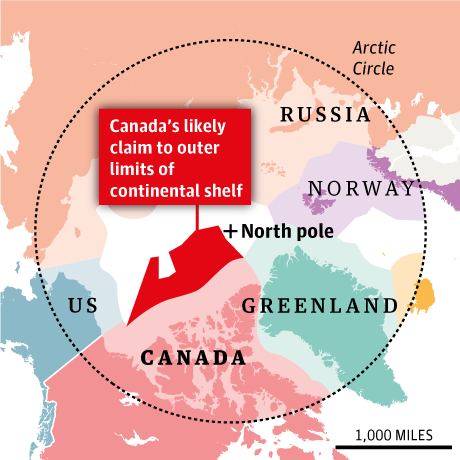


Russia has increasingly asserted itself as an Arctic nation. This year, it filed a United Nations claim for a vast swathe of the region including the North Pole, and it has been holding wargames in the area.

Parts of the same area are claimed by Canada, Norway, and the United States, among other Arctic nations.

The new Arctic Trefoil structure can house 150 soldiers and stock enough fuel and food to let them work and live there independently for a year and a half, the ministry said.


The soldiers can move around the base from one building to another without going outside to face winter temperatures which can reach minus 47 degrees Celsius (-57 degrees Fahrenheit). Roads have been built and fuel can be pumped in from tankers.

"No one has implemented similar projects at such a high latitude until now," said Northern Fleet Commander Admiral Vladimir Korolyov, adding that "the air defense units on combat duty in Russia's northernmost point are combat-ready and capable of performing their assigned missions." Hmmmm.....With Justine leading Canada now the Russians are safe. Read the full story here.

Thursday, August 13, 2015

Battle for the 'Russian' Arctic heating up.


Battle for the 'Russian' Arctic heating up. (RBTH).

Russian scientists say their new model for the Arctic's tectonic evolution shows that the underwater Lomonosov and Mendeleev Ridges are part of the Eurasian mainland. 
This apparently substantiates Russia's claim to 1.2 million square kilometers of Arctic sea shelf. At stake is control over vast natural resources, and opposition from western nations is almost certain.
Scientists from the Shirshov Oceanology Institute at the Russian Academy of Sciences have developed a new model for the Arctic's tectonic evolution that could help Russia — as well as several other countries — to support their territorial claims in the region.

The model proves that both the Mendeleev and the Lomonosov underwater ridges in the Arctic Ocean are in fact extensions of the Russian shelf, while the North Pole belongs to Denmark. 

Earlier this month Russia submitted its latest claims over the vast Arctic area to the UN Commission on the Limits of the Continental Shelf. If these are deemed valid, then access to significant parts of the Arctic could be off-limits to other nations.

The Arctic explained

The scientists claim their model is the most accurate to date since it was the first one to describe the actual tectonic plate movements in the Arctic and explain the origin of the basic tectonic structures of its seabed. The scientists say their model represents a huge step forward, paving the way to a completely new field of research --- the study and reconstruction of the mechanism behind the movement of the Arctic crustal blocks.

The Russian scientific data could also support shelf extension claims made by other countries, with some of them potentially extending their borders all the way to the North Pole. “Our colleagues from Norway, Canada, the United States and Denmark are quite interested in the model and are studying it with enthusiasm,” Leopold Lobkovsky, deputy director of the Shirshov Institute, told RBTH.

“We know now that the Gakkel Ridge, which Russia had previously claimed as well, is not an extension of the country’s shelf, but merely a part of the seabed,'' said Yuri Sychev, head of the Zubkov State Institute of Oceanography. “The North Pole – according to the equi-distance principle – should belong to Denmark, but this issue is still a subject of discussion between Copenhagen, Ottawa and Moscow. As for the Lomonosov and the Mendeleev Ridges, these are undoubtedly part of the Russian shelf.” 

The researchers have gathered unique cartographical and geophysical data that they expect will satisfy the UN commission. Russian scientific data shows that the ridges started moving away from the Eurasian continent 120 million years ago, but have never broken off from it.

A decade of research

Russia submitted a similar territorial claim in 2001, but it was rejected because it failed to provide convincing evidence. Establishing the new model took over 10 years of geological and geophysical studies and large-scale marine expeditions involving ice-breakers and scientific research ships. During one such expedition, drilling rigs deployed near the Mendeleev Ridge reached rock formations that could date back to almost 300 million years ago.   

“At the moment, the Arctic Ocean beyond the exclusive economic zone is open to ships from all states”, said Lobkovsky. “If the Russian claim is approved by the UN Commission, then a large part of the Arctic will no longer be considered international waters.''

Professor Vladimir Pavlenko, head of Russia’s Arctic Research Institute, believes the UN will approve Russia’s claims this time. “The rejection of the 2001 claim made sense; we had almost no accurate data at that point,'' said Pavlenko. “It was hard to expect any other outcome, but now we have every reason to expect an approval.”

Despite the new evidence, however, Russia's claim will continue to meet strong opposition from other countries, such as the USA and Canada, because at stake is a very resource-rich area of the Arctic.

The House Foreign Affairs Committee Chairman Ed Royce said the U.S. and its allies should stand up to Russia. “Russia has been aggressively pushing its claims to the Arctic, especially the resource-rich continental shelf. It now has an Arctic Command to strengthen its military presence in the region. The U.S. and others bordering the Arctic must maintain a united front against Moscow’s aggressive ambitions toward this vital region,” said Royce.  

Monday, August 10, 2015

Two brand new 'Armed' ice breaking rescue and salvage vessels for Russia are ready at Nordic Yards in Germany.


Two brand new 'Armed' ice breaking rescue and salvage vessels for Russia are ready at Nordic Yards in Germany. (BarendObserver).

The two identical vessels are icebreakers of the second highest ice class, suitable for rescue operations in harsh environments. They can be used both for icebreaking operations in harbors and waters with an ice thickness of 1m as well as for fire-fighting and combating oil spills from the sea.

“Beringov Proliv” will be based in the Sakhalin region, while “Murman” will be based in Murmansk, the shipyard says in a press release.

The vessels can study the ocean floor and damaged objects at depths of up to 1,000m. Furthermore, they are equipped with a helipad on the bow.

The Russian Federal Marine and River Transport Agency and German shipbuilder Nordic Yards in December 2012 signed a contract for the construction of two icebreaking rescue and salvage vessels to operate in Russian Arctic waters. The total volume of the orders was €150 million. Hmmm.....Russia has already a large fleet of Ice breakers, now they're getting armed ones. I Hope that Canada takes notes.

HT And Source:


Related:
US Coast Guard still wrangling with Only one 'retired' heavy ice breaker.

Russian nuclear build heavy ice breaker Yamal.

US Coast Guard still wrangling with Only one 'retired' heavy ice breaker. (Janes).

As human activity in the Arctic continues to expand, the chief of the US Coast Guard (USCG) remains concerned about the nation's limited ice-breaking capability and is continuing to advocate for recapitalising its obsolete fleet of heavy ice breakers.

"This is not a coastguard unique challenge. It's a global access challenge that requires a national solution," Admiral Paul Zukunft, commandant of the USCG, said on 24 February in his annual state of the coastguard address.

Polar-class USCGC Polar Star (WAGB 10), a 39-year-old cutter that has been reactivated, remains the United States' sole heavy ice breaker, with sister ship USCGC Polar Sea (WAGB 11) laid up in disrepair. The 16,000-tonne medium ice breaker USCGC Healy (WAGB 20) is also in service.

Demand for ice-breaking capability is only growing, as several recent cases have demonstrated, the commandant noted. Polar Star in mid-February steamed 900 miles and broke through 150 miles of ice to rescue a 207-ft fishing vessel, Antarctic Chieftan , hailing from New Zealand with 26 crew members, that had become stranded in the southern polar region. "Ponder that for a minute, what a truly spectacular rescue and what would happen if we weren't there," Adm Zukunft said. "What concerns me even more is that the United States has no rescue capability whatsoever had it been Polar Star who suffered a catastrophic [mechanical] casualty and become beset in ice."

A study commissioned by the USCG to assess the United States' future ice breaker requirement concluded that a fleet of three heavy and three medium ice breakers would fulfill the needs for operating in the polar regions.

Enticing shipbuilders to help on a new ice breaker also has been difficult. "When you try to incentivise a shipyard to building an ice breaker, most shipyards will not make the front-end capital investments to build one ship of one type. So there's been an expressed need for more than one ice breaker," Adm Zukunft told reporters.

USCG officials have been arguing for a 'whole-of-government' approach to funding a new ice breaker for some time, but the idea has yet to gain traction with US agencies with a vested interest, such as the Department of Defense, which also is struggling with its own budgetary problems.

To keep up with the burgeoning activity in the Arctic, the USCG is weighing options for bolstering its ice-breaking capability in the near term, including leasing ice breakers, reactivating Polar Sea , and possibly pursuing new ship acquisition. Hmmmm......Meanwhile the Russians have 6 heavy nuclear powered icebreakers, 7th is being build, and the have 39 diesel powered ice breakers. Good luck defending the arctic from Russia's appetite.China has 2 heavy ice breakers and one more coming in to service next year.Read the full story here.

Thursday, May 14, 2015

'Vorsprung durch technik' - Laser-equipped icebreakers could appear in Russian Arctic.


'Vorsprung durch technik' - Laser-equipped icebreakers could appear in Russian Arctic. (RBTH).

While the Arctic remains one of the least explored frontiers on Earth, various new ice protection devices, seismic prospecting technologies and power installations for ships have recently been appearing on the market.

One of the latest Russian inventions is a laser ice cutter, developed by the Moscow-based KURS research institute. Engineers at KURS believe their laser will revolutionize Arctic exploration, helping to increase traffic several-fold along the Northern Sea Route, the main shipping lane passing along the Russian Arctic coast. According to KURS Head Lev Klyachko, the project was based on research conducted by Russian scientists over the past decade and is approaching completion.

Science of ice slicing

The laser works like a glass-cutting tool, making incisions in the ice in front of an icebreaker to facilitate the passage of the vessel. The inventors claim the device will enable the making of wider paths in ice so that icebreakers can escort ships of greater width.

Experts at Rostec State Corporation (a Russian non-profit entity promoting the development of high-tech products) say the laser cutter will be economically profitable, as it will allow for the creation of new shipping lanes and increase traffic volumes.

Vladimir Pushkarev, the director of the Russian Arctic Exploration Institute, also emphasizes the issue of traffic. “If the laser can help speed up the icebreakers traveling along Northern seas, it must be installed,” Pushkarev told RBTH.

Can a laser be efficient in an Arctic climate?

The inventors at KURS say their laser cutters will be capable of making incisions and cuts in a layer of ice several meters thick and will help make passages possible for heavy icebreakers, as well as transport vessels. However, famous Russian polar explorer Viktor Boyarsky says the cold temperatures in the Arctic will restore the ice too quickly for the laser to cut through it efficiently. Hmmm....Nuclear powered icebreakers with Lasers.....has a ring to it. Read the full story here.

Saturday, November 15, 2014

Canadian PM Harper at G20 tells Vladimir Putin to 'get out of Ukraine'.

Not exactly John Wayne...but 'True Grit'.

Canadian PM Harper at G20 tells Vladimir Putin to 'get out of Ukraine'. (CBC).

Stephen Harper had a showdown with Vladimir Putin on Saturday, telling the Russian leader to "get out of Ukraine" in a dustup at the Group of 20 summit in Australia.

Harper's spokesman, Jason MacDonald, said the prime minister was speaking to a group of G20 leaders at a private leaders' retreat on Saturday morning when Putin approached and extended his hand.

MacDonald said Harper told Putin: "I guess I'll shake your hand but I have only one thing to say to you: You need to get out of Ukraine."

According to MacDonald, Putin did not respond positively. He didn't provide further details.

But a spokesman for the Russian delegation said Putin's response was: "That's impossible because we are not there."

Harper and the leaders of the world's top economies began the annual summit in a tense atmosphere dominated by Western anger towards Putin and pressure to address climate change, fight Ebola and kickstart economic growth.

A senior government source had earlier stated that Harper had no intention of talking to Putin during the summit, noting the Russian leader was well aware of Canada's position on his aggression in Ukraine. That changed when Putin approached his Canadian counterpart.

Harper has been a vehement Putin critic for months, with Canada and Russia trading a number of retaliatory sanctions.

He recently condemned the "continued penetration of Russian presence in eastern Ukraine and obvious actions to extend and provoke additional violence. That's of great concern to us." Read the full story here.

Thursday, October 16, 2014

Russia May Continue Arctic Shelf Exploration in 2015 to Submit Claim to UN: Explorer


Russia May Continue Arctic Shelf Exploration in 2015 to Submit Claim to UN: Explorer. (RN).

Russian scientists may need to carry out more Arctic shelf research in order to bolster the country's official claim for large swathes of seabed, polar explorer Artur Chilingarov told RIA Novosti Thursday.

"The claim is ready but there are certain objections. It is possible that we will have to conduct field work next year. We cannot make a mistake. It is under discussion if the claim submission should be moved to the next year. I do not rule out its submission in 2015," Chilingarov who is a Special Presidential Representative for International Cooperation in the Arctic and Antarctic, said.

"Arctic expeditions can only be carried out from July-September, or earlier, if there are ice-breakers. We are considering the issue right now," Chilingarov said.

The Russian Ministry of Natural Resources and the Environment is responsible for preparing the application to the UN. The document has to be forwarded to the Ministry of Foreign Affairs so that it can be submitted to the UN Commission on the Limits of the Continental Shelf, according to the explorer.

In April, Russian Natural Resources Minister Sergei Donskoi said that Russia plans to finalize its official claim this fall and hand it over to the UN next spring.

Moscow filed its claim to a part of the Artic continental shelf including the Lomonosov and Mendeleev Ridges in 2011, but the UN Commission on the Limits of the Continental Shelf said that it needed further scientific backing.

Scientists have to prove that the underwater ridges are extensions of the Eurasian continent, thus linked to Russia's territory. The shelf, which is believed to hold some five million tons of hydrocarbon reserves, is a lucrative resource-rich zone.
Related Posts Plugin for WordPress, Blogger...