Showing posts with label EU. Show all posts

Saturday, February 18, 2017

Merkel: 'The Euro is too low for Germany, If we still had the (German) D-Mark it would surely have a different value'.


Merkel: 'The Euro is too low for Germany, If we still had the (German) D-Mark it would surely have a different value'. HT: KeeptalkingGreece.

German Chancellor Angela Merkel suggested on Saturday that the euro was too low for Germany but made clear that Berlin had no power to address this “problem” because monetary policy was set by the independent European Central Bank.

Merkel made her remarks at the Munich Security Conference as U.S. Vice President Mike Pence looked on. They seemed aimed at addressing recent criticism from a top trade adviser to President Donald Trump, who has accused Germany of profiting from a “grossly undervalued” euro.

“We have at the moment in the euro zone of course a problem with the value of the euro,” Merkel said in an unusual foray into foreign exchange rate policy.

“The ECB has a monetary policy that is not geared to Germany, rather it is tailored (to countries) from Portugal to Slovenia or Slovakia. If we still had the (German) D-Mark it would surely have a different value than the euro does at the moment. But this is an independent monetary policy over which I have no influence as German chancellor.”


The euro has fallen nearly 25 percent against the dollar over the past three years, touching a 14-year low of $1.034 in January. But it has since risen to roughly $1.061.

In late January, Peter Navarro, the head of Trump’s new National Trade Council, said the euro’s low valuation was giving Germany an edge over the United States and its European Union partners. Read the full story here.

Related:

'What's Up Doc?' - Germany brings back 300 tons of reserve gold from US.

Thursday, February 9, 2017

'What's Up Doc?' - Germany brings back 300 tons of reserve gold from US.


'What's Up Doc?' - Germany brings back 300 tons of reserve gold from US.

Germany's central bank has completed an effort to bring home 300 tons of gold stashed in the United States, part of a plan to repatriate gold bars kept abroad during the Cold War.

The Bundesbank said 111 tons of gold were brought back from the Federal Reserve in New York in 2016, the last of 300 tons slated for return. It also repatriated 105 tons from Paris. 

The bank in 2013 launched the transfer to Frankfurt of 300 tons of gold from New York and 374 tons from Paris. It still has another 91 tons to return from Paris.

Once the transfers are completed this year, Frankfurt will hold half of Germany's 3,378 tons of reserve gold, with the rest in New York and London.


IN a relevant article Reuters writes:

Stashed away at the height of the Cold War in safe havens well out of Moscow’s reach, the 3,378-tonne, 120 billion-euro (102 billion-pound) gold stockpile has become a symbol of Germany’s economic ascent and a guardian of its stability.

But with Europe stumbling from crisis to crisis, the German public has grown uneasy about keeping the gold abroad. Some even argue the world’s second biggest bullion reserve may be needed to back a new deutschmark, should the euro zone break up.

Having already moved 583 tonnes of gold out of New York and Paris, the Bundesbank plans to have half its gold in Frankfurt by the end of 2017, years ahead of its 2020 schedule, with the rest split between the Federal Reserve Bank of New York and the Bank of England.

“We have a lot of discussions about (U.S. President Donald) Trump, regarding implications on monetary policy, macroeconomics, etc., but we trust the central bank of the U.S.,” Bundesbank board member Carl-Ludwig Thiele told a news conference.

“Trump has not triggered a discussion about the storage facility in New York,” he said.

With French Presidential candidate Marie Le Pen and Italy’s 5-Star Movement openly campaigning to pull their nations out of the euro, confidence in the common currency appears to be waning. (full article Reuters) Hmmm......Someone expecting a EU breakup?

Tuesday, December 20, 2016

So far, only 34,000 refugees, which means Two percent have found jobs in Germany.


So far, only 34,000 refugees, which means Two percent have found jobs in Germany. (TheLocal).

In the last two years 1.2 million people have arrived in Germany seeking asylum. New government figures show that getting into work takes time.


A total of 34,000 refugees have found work in Germany over the past 12 months, the figures released on Monday by the government’s Institute for Labour Research (IAB) showed.

Almost quarter (22 percent) of those who have found work are on temporary contracts.

The numbers are for refugees out of the eight most important countries of origin, including Syria, Iraq, Afghanistan and Eritrea.

If we manage to get 50 percent of them into work which pays for their lives in five years, that’d certainly be a success,” said Joachim Möller, director of the IAB.

But he cautioned that “it would be an illusion to believe that we will manage to find jobs for a decent proportion of refugees in well-paid industry jobs like car manufacturing.”

Möller added that temporary jobs were important to help refugees get a foot in the door.

“Many companies are sceptical, so temporary work can help them get a feel for someone.”

The refugee influx has also created between 50,000 and 60,000 jobs for Germans, with extra jobs in professions such as teacher and social worker likely to be needed for years to come, according to Möller.

Monday, December 19, 2016

Gazprom may cut off gas transit to Europe in case of unauthorized gas 'withdrawal' by Ukraine.


Gazprom may cut off gas transit to Europe in case of unauthorized gas 'withdrawal' by Ukraine.(Tass).

Gazprom sees some risks for gas transit through Ukraine to Europe, and in case of unsanctioned gas tapping by Ukraine it may cut off supplies to the EU, CEO of Gazprom Alexei Miller told reporters.


"Indeed there are risks for gas transit to Europe (via Ukraine). In the contract, which was signed in 2009, we clearly fixed all cases of force majeure. If Ukraine starts gas tapping, then we can either reduce supply by the volume of illegally taken gas or can carry out a disproportionate reduction. But we may stop deliveries all together even after a single unauthorized tapping of gas," Miller said.
Read the full story here.

Thursday, December 8, 2016

'Poor' Greece to become the 'refugee dump' of the European Union?


'Poor' Greece to become the 'refugee dump' of the European Union? (AA).

The European Union's executive said on Thursday that member states should be allowed to send some asylum-seekers back to Greece from mid-March, in a step Brussels hopes will help restore the bloc's migration policies, which collapsed under a mass influx last year.


Under EU rules, the first country of entry is responsible for handling an asylum claim, but that system broke down last year in Greece, the main gateway to Europe for more than a million refugees and migrants.

Unable to cope, Greece let many of them pass through on their own to Germany and other wealthy EU states in defiance of the bloc's rules. That led countries along the route gradually to close their borders, stranding many in Greece, which struggled to offer them proper shelter.

The European Commission on Thursday said Greece has improved in hosting and registering arriving asylum-seekers.

It recommended that EU states be allowed to send back to Greece asylum-seekers who enter the bloc that way and make it deeper into Europe from mid-March onwards. The recommendation does not apply to those who have already made that journey.

"This will provide further disincentives against irregular entry and secondary movements, and is an important step for the return to a normally functioning ... system," the Commission's deputy head, Frans Timmermans.

The bloc's asylum policy and its zone of internal free travel both collapsed last year as an uncontrolled flow of migrants and refugees triggered bitter disputes between EU states on how to handle them.

These disputes remain unresolved and more than 62,000 people are still in Greece, even though an EU agreement with Turkey in March reduced the arrivals to a trickle.

The failure is in large part due to reluctance by EU states to take in people from Greece and Italy to help process their asylum requests and ease the burden on the two frontline states.

So far, fewer than 8,200 people have been moved from these two Mediterranean countries to other EU states under a plan that was supposed to cover 160,000 people and which expires next September. The Commission called on EU states to step up.

"Our aim is to relocate all those in Italy and Greece who are eligible for relocation within the next year," said the bloc's migration chief, Dimitris Avramopoulos.

Brussels put additional conditions on returning people beyond March, saying Greece should give individual assurances of fair treatment for any returnees and that unaccompanied children not be sent back at all.

Obligatory quotas on refugees are now the focus of a tug of war between EU states seeking to reform their troubled common asylum rules.

The Commission said arrivals from Turkey to Greece stood at an average of 92 people a day since March, compared to thousands that were making at times making it in a single day before the deal with Ankara. It said 1,187 people have been deported from Greece to Turkey since March 2016.


Under the deal with Turkey, which looks fragile now due to a breakdown in ties following Ankara's crackdown in the wake of a botched military coup in July, Brussels also said it had spent 677 million euros of the 3 billion promised to help Syrian refugees living on Turkish soil.

Monday, October 24, 2016

Belgium's Wallonia Says Won't Meet EU 'Ultimatum' On Canada Trade Pact.


What's worse than a Quebecois? Their Original homeland habitants the Walloon's. (NDtv).

          Belgium's Wallonia Says Won't Meet EU 'Ultimatum' On Canada Trade Pact.


Brussels, Belgium:  The head of Wallonia's parliament said Monday it would not respect an EU ultimatum to back a massive trade deal with Canada blocked by the Belgian region.  

"It won't be possible to respect this ultimatum," Andre Antoine told RTL radio in Belgium, referring to a late-Monday deadline set by EU president Donald Tusk for the country to say whether it could support the pact.

Belgium has so far been the only EU member not to sign up to the CETA trade deal, which has been seven years in the making, because French-speaking Wallonia has refused to endorse it.

Antoine said it was important to get CETA right as it could pave the way for future trade pacts with powers such as the US and China. "We must therefore have a solid legal basis," he added.

He also pointed to the massively complex nature of the text, saying he has "300 pages of the treaty, 1,300 pages of appendices." Hmmm...Anyone knowing the close ties between Quebec and Wallonia knows why this deal won't pass. As Quebec farmers said in the past : "We can't compete against those high quality goods". Read the full story here.


Thursday, September 22, 2016

ETIAS - A 13-euro Visa entry fee for the EU?


ETIAS - A 13-euro Visa entry fee for the EU? (SG).

The EU is planning to massively increase its border controls. Those who want to enter have to register, or apply for a visa. The goal is more security, though EU citizens will be spared.

Australia’s had one for a long time, and the United States has had one since 2007: An electronic entry system for travellers who don’t need a visa. Now, the EU wants to implement such a system in order to have better control over who is actually entering and leaving the bloc.

In the US, the online electronic registration system is known as “ESTA.”

In Europe, it will be known as “Etias” (European Travel Information and Authorisation System).

The EU Commission is currently carrying out a feasibility study to determine how Etias can be set up at hundreds of airports and border crossings. The legislative process would then begin at the end of the year.


EU interior ministers called for a digital registration system last year following the terror attacks in Paris. But the system, designed to close recognized security loopholes, has been in planning for much longer. Now, it’s going to become a reality.

Similar to the US system, travelers who don’t need a visa for the EU will be required to register online. A fee will be charged for the process; according to EU officials, it could be anywhere between 13 and 50 euro ($15 and $56) (19 Can$). Based on the current 30 million travelers from non-EU countries who do not need a visa, that would create income of between 390 million to 1.5 billion euro per year.

The number of people who don’t need a visa but who will have to pay this “entry fee” could increase considerably in the next few years. After Brexit, millions of British people travelling to the EU for vacations or business trips will also have to pay and register with Etias. The same goes for people from Turkey or Ukraine, in the event that the EU grants them visa-free travel. According to Camino Mortera-Martinez of the Brussels-based think tank, the Center for European Reform, it’s a bad deal. “It would be damaging for British business,” she told Britain’s Guardian newspaper. Read the full story here. More here.

Friday, September 9, 2016

Inside the Turkish 'Labor' Camps Where Syrian Refugees Work for $8 a Day.

Source picture here.

Inside the Turkish 'Labor' Camps Where Syrian Refugees Work for $8 a Day. (NewsDeeply).

Thousands of Syrian refugees are now employed as migrant farm workers across Turkey, and they are particularly vulnerable to exploitation – especially as the 'Islamist' government has effectively sanctioned using them as cheap labor.

TORBALI, Turkey – “Look at this place. You can’t tell the difference between this camp and a toilet,” says Khadija, a 38-year-old Syrian mother of four, as she gestures around her home: a tent inside a concrete warehouse, made of dusty carpets draped over haphazardly positioned metal rods.

The warehouse in this small farming village on the outskirts of the Turkish coastal city of Izmir is home to almost 200 refugees. Many of them, like Khadija, work long hours as farmhands in the nearby fields.

In Turkey, many landowners see Syrians like Khadija as an opportunity to cut costs, and, much to the chagrin of some locals who have worked the fields for generations, hire the refugees as their new, cheaper workforce.

While the average Turkish farm laborer earns 60 lira (around $20) per day, a Syrian refugee performing the same job earns half that amount. Women earn as little as 20 lira (around $8) per day and, since they are cheaper labor, are employed more often.


In May, this system of temporary labor in Turkey was further institutionalized with the passing of the Private Employment Offices bill, which allows employers to purchase labor through a bureau – a “middle man” figure who effectively eliminates responsibilities for any regulations for the workers, or work performed. This opens the door to long hours, temporary workplaces and workers being instructed to relocate at a moment’s notice. Hmmmm......Perhaps the EU Should give the Sultan a couple of Billion Euros more? Read the full story here.

Wednesday, June 29, 2016

Video - Hollande says UK must accept EU conditions for market access.


Monday, May 30, 2016

"Deteriorating rule of law in Turkey certainly not bringing it closer to Europe" EP Turkey Rapporteur Kati Piri.

Source Quote here

Vocal Europe: How do you see the recent political changes in Turkey, especially the resignation of the former Prime Minister, Mr. Davutoglu ? He was replaced by Mr. Binali Yıldırım, former Minister of Transport and Communication, a close ally to President Erdogan? Do you think that this shift is going to bring Turkey closer to the European Union or to drift it away?

Kati Piri: I think that this change would make clear and what most Turks already knew is that there is no separation of powers between the government and the President: there is one leadership who is President Erdogan.


What we are observing now in Turkey is more centralization of the power in the hands of one person. The new government was announced from the Presidential Palace and that does not need more comments than stating the facts: Turkey is heading to a presidential system.

That in itself is not good or bad, closer or not closer to Europe, as we have presidential systems in Europe as well and I cannot say that they are less democratic.

Though, a system without any checks and balances, at a moment when we see those political developments and, at the same time that the rule of law is deteriorating in the country, is certainly not bringing Turkey closer to Europe. Read the full interview here.

Sunday, May 22, 2016

EU complains Turkey is sending ill and less-educated Syrians, refuses to send Syrian academics.


EU members complains Turkey is sending ill and less-educated Syrians, refuses to send Syrian academics. (MEM).

EU members have complained to Turkey for sending unwell Syrians to Europe as part of a controversial migrant swap deal, German daily Der Spiegel reported on Saturday.

Under a deal that came into force in March, the EU will resettle one Syrian refugee from camps in Turkey in exchange for each asylum seeker deported back to Turkey after arriving in Europe by boat.
So far around 400 people have been returned to Turkey under the deal, meaning in theory that 400 others have been resettled in Europe.

However, amid legal challenges to the deal, Der Spiegel's report suggests that tensions over the fine print could also be putting it at risk.

At a recent internal EU meeting in Brussels, a representative of Luxembourg reportedly criticised Turkey for sending “serious medical cases” as well as less-educated Syrians as part of the scheme.

Germany's parliamentary state secretary in the interior ministry, Ole Schroeder, also reported to the country's parliament this week that Turkey is not sending highly educated Syrians to Europe.

Turkey has informed UNHCR, the UN's refugee agency, that Syrian academics may not be included in the scheme and resettled to Europe.

UNHCR is usually in charge of identifying people eligible for refugee resettlement programmes, but in this case Turkey has insisted that it be in charge of selecting candidatesHmmmm.......From the start i warned that Turkey would 'select' them, this is the result. How to poison a continent in easy steps. Read the full story here.

Wednesday, May 11, 2016

EU-Turkey 'deal' not legally binding, says EP legal chief.


EU-Turkey 'deal' not legally binding, says EP legal chief. (EUObserver).
The EU-Turkey deal was "nothing more than a press communique", the lawyer said.
The legal arm of the European Parliament on Monday (9 May) spoke out against the EU deal with Turkey.

It noted the statement between the two on 18 March is nothing more than a press release, which has no legal bearing.

"This statement was nothing more than a press communique," the parliament lawyer told MEPs in the civil liberties committee. "This statement is not a binding agreement."

He noted the statement came without any signatures and was not published in the Official Journal of the European Union.

"It is very difficult to conclude that both the European Union and Turkey wanted to be legally bound under international law by this declaration," he said.

"It is really a long way from the drafting standards of any international agreement," he said.
Despite the lack of clarity behind the statement, it still conforms to EU law, he noted.

Parliament will still have to sign off on visa-waiver plans and other issues like the budget and the resettlement of people on the one-to-one migrant swap deal. Hmmm.........Who authorized the 6 Billion Euro in aid to Turkey? Read the full story here.

Wednesday, May 4, 2016

EU Proposes to Extend Border Controls inside Schengen Area for another six months.


EU Proposes to Extend Border Controls inside Schengen Area for another six months. (Novinite).

The European Commission has proposed to extend for up to six months temporary controls at internal Schengen borders in five Member States which attract the majority of refugees and migrants streaming into Europe.

The proposed recommendation, to be decided upon by the Council of the EU, takes into account the fact that despite the significant progress made by Greece, not all of the serious deficiencies identified in the country’s external border management could be adequately and comprehensively addressed within the three months' limit, the Commission said in a statement on Wednesday.

The five countries - Austria, Denmark, Germany, Norway and Sweden - have already temporarily reintroduced controls at some of their borders to curb the the threat to internal security resulting from the secondary movements of irregular migrants.

The reintroduction of controls is foreseen under the Schengen Borders Code, which sets out a specific procedure for exceptional circumstances where the overall functioning of the Schengen area is put at risk by serious and persistent deficiencies at an EU external border.

The Commission has recommended that Austria kept controls at its borders with Hungary and Slovenia; Germany – at its land border with Austria; Denmark – at its ports with ferry links to Germany as well as the Danish-German land border.

The recommendation gives Sweden the right to keep border controls in the country’s harbours in the south and west as well as at the Oresund bridge, while Norway is to keep border checks at its ports with ferry links to Denmark, Germany and Sweden.

Saturday, April 16, 2016

Iran calls on EU to confront and force US on nuclear deal implementation.


Iran calls on EU to confront and force US on nuclear deal implementation. (Taz).

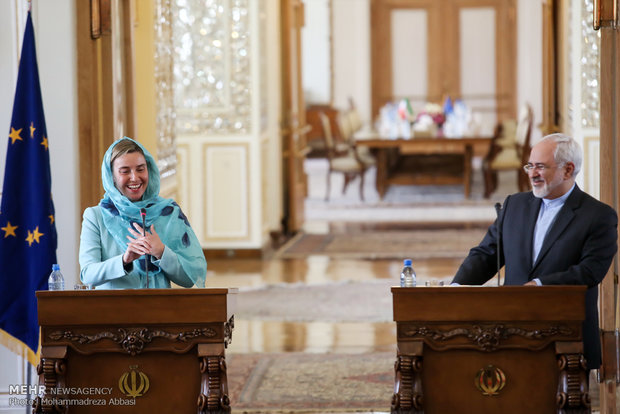
Secretary of the Supreme National Security Council (SNSC) of Iran Ali Shamkhani has asked the EU to confront with what he called Washington's "obstruction" of nuclear deal implementation.

In a meeting with the visiting EU High Representative for Foreign Affairs and Security Policy Federica Mogherini on April 16, Shamkhani underlined that the Europe Union played a pivot role in concluding the JCPOA (Joint Comprehensive Plan of Action, aka nuclear deal), Iran's state-run IRINN TV reported.

Shamkhani further said that the achievement needs to be protected and implemented via continues cooperation of the EU.
He argued that the US is seeking to continue its sanctions policy against Iran and is troubling the implementation of the JCPOA, referring to Washington's approach as "undesirable and unconstructive".

Shamkhani further said that if the EU fails to adopt effective action against the US approach, the United States' present course of action will entail negative repercussions for continued cooperation and implementation of mutual commitments under the nuclear deal.

Earlier the same day, Iran's Foreign minister, Mohammad Javad Zarif, underlined that the other parties, in particular the US, should in practice fulfill their obligations under the nuclear deal.

Speaking at a joint press conference with Mogherini, Zarif said Washington should do more to remove obstacles to Iran's banking system.

Earlier, Valiollah Seif, the head of Iran's central bank, accused the US and the EU of failing to honor the JCPOA by keeping Iran locked out of the international financial system.


"In general, we are not able to use our frozen funds abroad," Seif said Apr. 15 at the Council on Foreign Relations in the US. Hmmm......Mogherini to the rescue. 


Sunday, April 3, 2016

Jaroslaw Kaczynski A Polish Putin: Autocratic Power Grab Accelerates in Warsaw.


Jaroslaw Kaczynski A Polish Putin: Autocratic Power Grab Accelerates in Warsaw. (Spiegel).

Poland's national-conservative government was quick to sideline the country's high court. Now, Jaroslaw Kaczynski and his party have their sights set on complete control of the state.

At age 73, she is the grande dame of politics in Warsaw -- and she still talks so much and so fast that hardly anyone can get a word in edgewise. More than anything, though, Jadwiga Staniszkis is not afraid of those in power.

Even as a young assistant professor during communist times, her defiance got her into trouble and she spent some time in prison as a result.

Today, 27 years after the fall of communism, Staniszkis is once again taking on the authorities. The sociology professor has become one of the most outspoken critics of the current national-conservative government under the control of Jaroslaw Kaczynski.

Although Kaczynski has no formal position in the government, he is widely seen as the one pulling the strings in the background.

Staniszkis was long a fan of Kaczynski and has even campaigned for his national-conservative Law and Justice (PiS) party in the past. She once gushed: "I think he is perhaps the most intelligent politician in Poland. I like him a lot."

Today, she says: "He wants to monopolize power with no limitations. The approach is informed by a Bolshevik understanding of politics."

Kaczynski has placed state-run media in Poland under his control and weakened the country's highest court, known as the Constitutional Tribunal. And that was just the beginning.

The Warsaw-based newsmagazine Polityka has even described it as a coup d'état. There have been large protests in the country, harsh criticism from Brussels and a rule of law inquiry from the EU, but nothing has yet stopped Kaczynski.

Now, on his path to absolute power, he is preparing to put every last aspect of the state under his control. Already, he can rely on his party's majority in Polish parliament to do his bidding. But he apparently has aspirations beyond just dominating ministries, state agencies and the judiciary. Under his leadership, the state is to take on a stricter, fatherly role -- not unlike an autocracy.


In the battle over the Constitutional Tribunal, Professor Staniszkis knows the primary adversaries well. Both Andrzej Rzeplinski, who is president of the court, and Jaroslaw Kaczynski, who has robbed the court of its power, attended her university classes.

Professor Staniszkis, who has known Jaroslaw Kaczynski for several decades, has not been allowed to see him for months. The two don't have that much to say to each other anyway. "He doesn't understand the Western concept of sovereignty, which uses a system of checks and balances to prevent a dictatorship of the majority," says Staniszkis. Her former student, she adds, wants absolute power. "It is archaic and reminiscent of Putin's approach to power." Read the full story here.

Sunday, March 6, 2016

Germany - Merkel expects refugees to respect German laws and way of life.


Germany - Merkel expects refugees to respect German laws and way of life. (Tass).

German Chancellor Angela Merkel expects migrants arriving in Germany to respect the local way of life and visit integration courses.

"I expect the people who are seeking our protection and shelter to be open towards our country and our way of life. Naturally, I expect them to respect our laws.

Those who have prospects to stay have the right to visit an integration course, which includes 600 hours of language studies. This should be taken into account," Merkel said in an interview with the Bild am Sonntag newspaper.

Merkel told Bild am Sonntag that Germany would not give up a deficit-free budget because of the influx of refugees.

"A budget without any new debts is appropriate for countries with aging population. We seek to achieve this budget for the sake of future generations," the chancellor said.

A balanced and deficit-free budget is one of the key goals of Germany’s incumbent ruling coalition. First, it was adopted in 2015 and then in 2016 despite huge migrant flows. Prior to that, the government passed a deficit-free budget back in 1969. Read the full story here.
Related Posts Plugin for WordPress, Blogger...