Showing posts with label Foodstamp presidency. Show all posts

Friday, January 10, 2014

JPMorgan To Exit Foodstamp, Other Prepaid Cards Business.


JPMorgan To Exit Foodstamp, Other Prepaid Cards Business.(Zero Hedge).
Mess with us, we'll mess with you. That is the message one can derive from JPMorgan's surprise announcement that it plans to "sell or wind down its business of issuing prepaid cards for corporate payrolls and government tax refunds and benefits." 
Which also includes the infamous Electronic Benefits Transfer, or foodstamps, card. According to Reuters, the product, which has been offered with cash and treasury services to companies and governments, "had become a headache of risks in operations and regulations, according to a person familiar with the matter who was not authorized to speak publicly."

 
Curiously, it was just over two years ago when JPM said this about its EBT business:
This business is a very important business to JP Morgan,” Christopher Paton, the company’s managing director of treasury services, told Bloomberg News in 2011. “It’s an important business in terms of its size and scale.We also regard it as very important in the sense that we are delivering a very useful social function. We are a key part of this benefit delivery mechanism. Right now volumes have gone through the roof in the past couple of years or so … The good news from JP Morgan’s perspective is the infrastructure that we built has been able to cope with that increase in volume.”
Guess the social function isn't that important any more. However, along with the responsibilities, JPM is losing a substantial revenue stream
Just how lucrative JP Morgan’s EBT state contracts are is hard to say, because total national data on EBT contracts are not reported. But thanks to a combination of public-records requests and contracts that are available online, here’s what we do know: 18 of the 24 states JP Morgan handles have been contracted to pay the bank up to $560,492,596.02 since 2004. Since 2007, Florida has been contracted to pay JP Morgan $90,351,202.22. Pennsylvania’s seven-year contract totaled $112,541,823.27. New York’s seven-year contract totaled $126,394,917.
EBT processors charge for other services as well. For example, any time TANF recipients withdraw their cash benefits or make balance inquiries through out-of-network ATM machines, the user may incur ATM transaction fees generally ranging from $.75 to $1.50. In addition, most states allow EBT processors to charge card replacement fees. Arizona cardholders, for example, are permitted one free replacement a year, after which a $5 per card fee is imposed. The same goes for customer service calls: After an EBT cardholder exceeds the state’s maximum number of free calls, EBT processors typically tack on a $.25 per call fee.
That's a lot of money that one doesn't easily give up on. But that's what JPM just did.

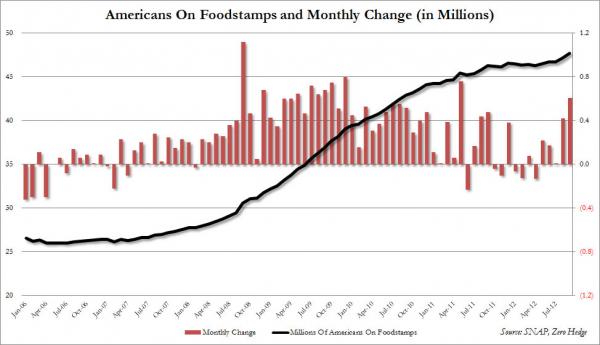
Or in other words, JPM just told the government which has been going after it relentlessly for the past year, forcing JPM to rack up some $25 billion in litigation reserves, "you can find someone else to manage your wholesale welfare program for nearly 50 million Americans."
There is more:
Last month JPMorgan warned some 465,000 holders of the cards that their personal data may have been accessed by computer hackers who attacked its network in July.
Government regulators are focusing on whether corporate payroll programs that use the cards have sufficient safeguards against burdening employees with fees.
For the past year the company has been moving to simplify its operations after its risk controls and guards against money laundering were found deficient by regulators.
According to JPMorgan's statement, the bank "will explore a full range of options for its prepaid card business, including a sale."
In the meantime, it will continue to support current clients and cardholders. The decision does not affect Chase customers holding credit, debit or prepaid "Liquid" cards, the company said.

Needless to add here, the last thing the precarious "recovery" needs right now are glitches with the EBT system, which as we saw last October when the EBT system briefly went "dark" nearly plunged the nation into a wholesale panic. Then again, such is quid pro quo life when the government bites one of the biggest hands that feed it.Hmmmm..........Someone knows the 'food stamp business' is coming to an end.Read the full story here.

Tuesday, October 15, 2013

End of 'foodstamp Presidency' in sight? Food stamp recipients delivered one-two punch by govt shutdown.


End of 'foodstamp Presidency' in sight? Food stamp recipients delivered one-two punch by govt shutdown.(RT).

Food stamps are fully paid for through October, according to a shutdown plan released by the US Department of Agriculture (USDA) on October 1. The plan outlined what would happen to federal nutrition programs once the government closed absent a funding agreement from Congress.

A $2 billion contingency fund exists for states that need administrative assistance should the shutdown last beyond November 1.

The supplemental nutrition assistance program, known as SNAP, is available to low-income Americans who need help purchasing food. It is funded by the federal government though the USDA, although it is administered by individual states.

The federal government shutdown that began on October 1 has put a spotlight on the program and other federal nutrition initiatives that Americans increasingly rely on for support.

Recipients and providers are beginning to receive more direct notices of what awaits, should the shutdown not be resolved by next month.

In Utah, Fox News 13 in Salt Lake City reported that a local provider recently received a letter from the USDA sticking to the November 1 cut-off date.

“This is going to create a huge hardship for the people we serve here in our food pantry,” Bill Tibbits, Associate Director at Crossroads Urban Center, told Fox News 13.

“What this means [is] if there’s not a deal, if Congress doesn’t reach a deal to get federal government back up and running, in Utah about 100,000 families won’t get food stamp benefit,” added Tibbits.

The USDA letter says in part, “in the interest of preserving maximum flexibility, we are directing states to hold their November issuance files and delay transmission to state electronic benefit transfer vendors until further notice.”

Regardless of whether the shutdown is resolved by November, a temporary boost in SNAP funding associated with the 2009 federal stimulus program will sunset on October 31.

The stimulus, or American Recovery and Reinvestment Act of 2009, added $45.2 billion to the SNAP budget, increasing benefits from $588 a month to $668 for an average household of four.

Upon the sunset, a family of four will see a five percent cut to benefits, according to AP.

That cut comes out to average less than $1.40 per person per meal in fiscal year 2014, according to the Center on Budget and Policy Priorities.

One in seven - or 47 million - Americans receive SNAP benefits. Around half of those are children and teenagers. Mississippi is the state with the highest number of recipients - 22 percent of its population is enrolled in the program.

Census figures reported in September showed that in 2012, around 15 percent of Americans lived at or under the poverty level, which is $23,550 yearly income for a family of four.

The US House voted in September to cut SNAP funding by $39 billion over the next decade. The nonpartisan Congressional Budget Office estimated that such a level of cuts would cause up to 3.8 million people to lose food stamp benefits in 2014.

The Senate had previously voted to cut $4 billion to the program in that time period.

Another major federal nutrition program, WIC (Women, Infants and Children), is also set to shut down around November 1, based on USDA projections, and will not receive further funding. However, the USDA told Education Week that some states are capable of prolonging current funding.

USDA is working with WIC state agencies to use all available funding resources to provide benefits to participants. [Food and Nutrition Service] will be allocating both contingency and carryover funds to state agencies for use in operating their FY 2014 WIC program, in addition to other available funds. Should a lapse extend through late October, federal WIC funding may not be sufficient to cover benefits, the USDA’s Bruce Alexander said.

Sunday, October 13, 2013

Computer Glitch Blamed For Nationwide EBT System Shutdown On Saturday.


Computer Glitch Blamed For Nationwide EBT System Shutdown On Saturday.(CBS).

BOSTON (CBS/AP) - People in Ohio, Michigan and 15 other states found themselves unable to use their food stamp debit-style cards on Saturday, after a routine test of backup systems by vendor Xerox Corp. resulted in a system failure. At about 9 a.m. Saturday, reports from across the country began pouring in that customers’ EBT cards were not working in stores.

At 2 p.m., an EBT customer service representative told CBS Boston that the system was currently down for a computer system upgrade.

Xerox spokeswoman Jennifer Wasmer released further details later in the afternoon in an emailed statement.

While the electronic benefits system is now up and running, beneficiaries in the 17 affected states continue to experience connectivity issues to access their benefits. Technical staff is addressing the issue and expect the system to be restored soon,” Wasmer said. “Beneficiaries requiring access to their benefits can work with their local retailers who can activate an emergency voucher system where available. We appreciate our clients’ patience while we work through this outage as quickly as possible.”

Wasmer said the affected states also included Alabama, California, Georgia, Iowa, Illinois, Louisiana, Massachusetts, Maryland, Mississippi, New Jersey, Oklahoma, Pennsylvania, Texas and Virginia.

U.S. Department of Agriculture spokeswoman Courtney Rowe said the outage is not related to the government shutdown.

Shoppers left carts of groceries behind at a packed Market Basket grocery store in Biddeford, Maine, because they couldn’t get their benefits, said fellow shopper Barbara Colman, of Saco, Maine. The manager put up a sign saying the EBT system was not in use. Colman, who receives the benefits, called an 800 telephone line for the program and it said the EBT system was down due to maintenance, she said.

Oklahoma also runs a separate debit card system for other state benefits like unemployment payments. Those cards can be used at ATMs to withdraw cash. Powell said Xerox administers both the EBT and debit card systems, and they both were down initially.

Like Ohio’s Johnson, Powell said that Oklahoma’s cash debit card system has since been restored, but the EBT cards for the SNAP program were still down. Powell said Oklahoma’s Xerox representative told them that the problems stemmed from a power failure at a data center, and power had been restored quickly.

It just takes a while to reboot these systems,” she said, adding that she did not know where the data center was located.

The federal EBT website was unavailable due to the government shutdown. Hmmmm........“It just takes a while to reboot these systems,” she said, adding that she did not know where the data center was located.......Don't tell me ......let me guess:$2 Billion NSA Spy Center is Going Up in Flames.

Sunday, September 22, 2013

Video - "The Food Stamp Nation"


Source: Zero Hedge
From the art of selling excess food stamp dollars at the end of each month, to JP Morgan profiting from the program as a line of business, Liberty Blitzkrieg’s Mike Krieger introduces the following micro-documentary on the rise of our food stamp nation. Produced by Future Money Trends, this video covers it all, exposing the dismal and far-reaching consequences to society.

Thursday, September 19, 2013

"Foodstamp Presidency" - House Food Stamps Legislation.

Guess when Obama became President.

"Foodstamp Presidency" - House Food Stamps Legislation.(Cato).Tad DeHaven

Farm bills traditionally contain both farm subsidies and food subsidies (e.g., food stamps).

Unable to pass a traditional farm bill passed this year, the House Republican leadership separated the two components. The House passed a stand-alone farm subsidy bill in the summer and now it’s set to vote on a bill that would trim the Supplemental Nutrition Assistance Program (a.k.a., food stamps) by $39 billion over ten years. 

The cost of the food stamps program has seen a dramatic rise since 2000. Both Republicans and Democrats supported expansions of the program in the 2000s. And because the program is counter-cyclical, the rolls exploded with economic downturn and weak recovery.   
Some quick comments:
  • Both Democrats and Republicans support the federal food stamps program. Those of us who believe that responsibility for helping those in need should be handled at the state level (or, ideally, by private means) really don’t have a dog in this fight. 
  • House Republicans previously voted to continue handing out taxpayer money to well-to-do farmers, landowners, and insurance companies. I have no beef with attempts to rein in the food stamps program, but targeting a traditional welfare program for cuts after boosting corporate welfare isn’t just hypocritical – it’s disgraceful. 

  • Accusations that the GOP’s proposed cuts would lead to people starving in the streets are absurd. State and local government officials who believe that the cuts would unduly harm their constituents should ask their taxpayers if they’d be willing to pick up the slack. And, the last I heard, government hasn’t completely crowded out private charitable giving.  


Wednesday, September 18, 2013

"CHANGE" - Median Household Income Has Fallen For FIVE YEARS IN A ROW.


"CHANGE" - Median Household Income Has Fallen For FIVE YEARS IN A ROW.HT: Economic Collapse

If the economy is getting better, then why do incomes keep falling?  According to a shocking new report that was just released by the U.S. Census Bureau, median household income (adjusted for inflation) has declined for five years in a row.

This has happened even though the federal government has been borrowing and spending money at an unprecedented rate and the Federal Reserve has been on the most reckless money printing spree in U.S. history.  Despite all of the “emergency measures” that have been taken to “stimulate the economy”, things just continue to get worse for average American families.  Americans are working harder than ever, but their paychecks are not reflecting that.  Meanwhile, the cost of everything just keeps going up.  The Federal Reserve insists that inflation is “low”, but anyone that goes grocery shopping or that stops at a gas station knows that is a lie.  In fact, if inflation was calculated the exact same way that it was calculated back in 1980, the inflation rate would be somewhere between 8 and 10 percent right now.  Paychecks are being stretched more than ever before, and that is probably the reason why about three-fourths of the entire country is living paycheck to paycheck at this point.
According to the Census report, the high point for median household income in the United States was back in 1999 ($56,080).  It almost got back to that level in 2007 ($55,627), but ever since then there has been a steady decline.  The following figures come directly from the report, and as you can see, median household income has fallen every single year for the past five years…
2007: $55,627
2008: $53,644
2009: $53,285
2010: $51,892
2011: $51,100
2012: $51,017
How far does that number have to go down before we admit that we have a major problem on our hands?
The new Census report also revealed that 46.5 million Americans are living in poverty.  As CNSNews.com noted, this is far higher than when Barack Obama first entered the White House…
During the four years that marked President Barack Obama’s first term in office, the real median income of American households dropped by $2,627 and the number of people on poverty increased by approximately 6,667,000, according to data released today by the Census Bureau.
So why does Obama continue to insist that things are getting better?
Right now, one out of every five households in the United States is on food stamps.
One out of every five.
How bad does it have to get before we acknowledge that what we are doing economically is not working.
Will half of us eventually end up on food stamps?
In addition, the new Census report also says that 48 million Americans are currently without any kind of health insurance whatsoever.
The biggest culprit for this is the stunning decline of employment-based health insurance.  Back in 1999, 64.1 percent of all Americans were covered by employment-based health insurance.  Today, only 54.9 percent are covered by employment-based health insurance.
And of course as I noted yesterday, even more companies are going to be dumping health insurance plans because of Obamacare.
All in all, what we have been witnessing over the past decade and a half is the systematic evisceration of the middle class.
After accounting for inflation, right now 40 percent of all U.S. workers are making less than what a full-time minimum wage worker made back in 1968.
Over the years, our incomes have certainly gone up, but inflation has increased even faster.
Back when I was growing up, $50,000 a year sounded like a whole lot of money.  I thought that anyone should be able to live a very comfortable lifestyle on that amount of money.
Unfortunately, $50,000 a year doesn’t go nearly as far as it once did.
If you take the current median household income ($51,017) and divide it up by 12 months, it comes to just a little bit more than $4000 a month.
And as I noted last year, it is not easy for the average American family to do everything that it needs to do on $4000 a month…
So can an average family of four people make it on just $4000 a month?
Well, first of all you have got to take out taxes.  After accounting for all forms of taxation you will be lucky if you have $3000 remaining.
With that $3000, you have to pay for all of the following…
*Housing
*Power
*Water
*Food
*Phone
*Internet
*At Least One Vehicle
*Gasoline
*Vehicle Repairs
*Car Insurance
*Health Insurance
*Dental Bills
*Home Or Rental Insurance
*Life Insurance
*Student Loan Debt Payments
*Credit Card Payments
*Furniture
*Clothing
*Pets
*Entertainment (although it is hard to imagine any money will be left for that)
Have I left anything out?
The truth is that $3000 does not go as far as it used to.
No wonder American families are feeling so stretched financially these days.
The new Census report also noted that the gap between the wealthiest Americans and the rest of us continues to grow.  There is certainly nothing wrong with making money, but if the economy was working properly all Americans should be able to have the opportunity to better themselves.
According to CNBC, the 400 wealthiest Americans now have more money than the poorest 50 percent of all Americans combined.
So why is this happening?  Well, certainly there are a lot of reasons, but in recent years quantitative easing has definitely played a role.  As I noted in my recent article about the Federal Reserve, quantitative easing has been incredibly good for those with stocks and other forms of financial investments.  All of that liquidity has juiced the financial markets, and the extremely wealthy have been loving it.
Meanwhile, things just continue to get even tougher for most of the rest of the American people, and the frightening thing is that the next major wave of the economic collapse has not even hit us yet.
How bad will things be for average American families once that happens?
And there are certainly lots of troubling signs as we get ready to head into the fall season…
-Total mortgage activity has dropped to the lowest level that we have seen since October 2008.
-One of the largest furniture manufacturers in America was just forced into bankruptcy.
-According to the Wall Street Journal, the 2013 holiday shopping season is already being projected to be the worst that we have seen since 2009.
Hopefully the slow and steady economic decline that we have been experiencing will not accelerate into a full-blown avalanche any time soon.
But I would definitely get prepared just in case.

Wednesday, September 11, 2013

GOP bill blocks food stamp users from buying junk food.


GOP bill blocks food stamp users from buying junk food.HT: TheHill.
Rep. Phil Roe (R-Tenn.) on Tuesday proposed legislation that would require people using federal food stamps to buy only healthy food.
The Healthy Food Choices Act, H.R. 3073, reflects a long-standing criticism that the government's Supplemental Nutrition Assistance Program (SNAP) allows people to buy billions of dollars worth of junk food. A 2012 study found that food stamps enable about $2 billion worth of junk food purchases each year, and that more than half of all SNAP benefits are used to buy sugary drinks.

Efforts to curb these purchases have been opposed by anti-hunger groups. But Roe said some states are already exploring ways to curb junk food purchases through the SNAP program, and argued that the federal government needs to take steps as well.

"Already, states like Wisconsin and South Carolina have shown interest in improving the healthfulness of choices in their SNAP programs," he said. "By giving SNAP recipients more nutritious choices, we can take a meaningful step towards ending hunger in America."

Under Roe's bill, food purchased under SNAP would have to meet the same guidelines that food purchased under the Women, Infants and Children (WIC) program already have to meet. The WIC guidelines are strict, and are made up of several different standards for products like breakfast cereal, milk, vegetables, peanut butter and other foods.

Breakfast cereal, for example, must contain certain levels of iron, cannot contain more than 21.2 grams of sugar per 100 grams of cereal, and must have whole grain as a primary ingredient in order to be bought under the WIC program.

Roe said those sorts of standards promote health, and should be emulated by the SNAP program.

"As a physician, I realize the importance of healthy eating, and as an obstetrician, I've seen how the WIC program helps empower families receiving assistance to use taxpayer dollars to purchase healthy, wholesome foods," he said. "If these guidelines are good and healthy enough for women and children, then SNAP recipients should also benefit from adhering to the same standards."

  Hmmm.....Then start making healthy food cheaper, otherwise there going to a whole lot of Hungry voters.Read the full story here.

Tuesday, September 3, 2013

Fed Judge Rules Food Stamp Recipients Can Unionize in order to assure an uninterrupted flow of payments should the fed gov be forced to temporarily shut down


Fed Judge Rules Food Stamp Recipients Can Unionize in order to assure an uninterrupted flow of payments should the federal government be forced to temporarily shut down.HT: Cei.org. By William Frezza.

In a surprise ruling, a three judge panel of the Ninth Circus Court of Appeals issued a unanimous opinion supporting the right of Supplemental Nutrition Assistance Program (SNAP) recipients to unionize in order to assure equitable access to benefits, along with an uninterrupted flow of payments should the federal government be forced to temporarily shut down due to congressional budget stalemates.
"For too long so-called Food Stamp beneficiaries have been denied access to union representation seeking to protect their rights," said Justice Gavin Moore Freestuff. In a sharply worded rebuke to attorneys representing the National Taxpayers Union, which sought to block a ruling by the newly reconstituted National Labor Relations Board (NLRB), Justice Freestuff cited recent court precedents establishing the right of home health care workers, nannies, babysitters, and dog walkers to pay compulsory dues which unions could then use to influence elections.
Under the new rules, if a majority of SNAP recipients in any congressional district signs ballot cards accepting the representation of a federally recognized labor union, all SNAP beneficiaries in that district would have 30 days to voluntarily enroll or lose benefits.
Monthly union dues would then be automatically deducted from recipients' Electronic Benefits Transfer (EBT) cards, minus a small fee for the card processor.

Eyeing 47 million potential new members, the American Federation of State, County and Municipal Employees (AFSCME) immediately launched an organizing drive, claiming that since Food Stamp recipients were on the government payroll and contributed just as much to the economy as other government employees, their organization would offer the most appropriate representation.

AFL-CIO President Richard Trumka begged to differ. "Were it not for decades of untiring efforts by our brothers and sisters to drive domestic manufacturers out of the country-or if necessary out of business-there is no way we would have so many Food Stamp recipients today. It is only right that we be allowed to recruit these critical providers of aggregate demand to replenish our dwindling membership."

EBT card processor JPMorgan Chase said it could begin deducting union dues as early as October 1, provided unions selected by cardholders cover a modest fee for software to enable funds to be deposited directly into designated politicians' campaign accounts. JPMorgan Chase stock rose four dollars on the news.
If even half of the nation's SNAP recipients elect to join a union, the $100 per month dues would total approximately half a billion dollars a year. Thanks to the Supreme Court's Citizens United ruling, that money will mostly likely be spent assuring fair and balanced elections, thereby ending gridlock in Washington. The subsequent increase in SNAP benefits that would occur once those goals are achieved would easily cover the monthly deductions.

The Reverend Al Sharpton declared a national day of thanksgiving, organizing candlelight vigils to thank the Court, as well as newly appointed member of the NLRB who made this historic civil rights achievement possible.

In related news, Grover Norquist's doctors at the Bethesda Naval Hospital report he is out of danger and recovering nicely after the heart attack he suffered upon learning of the ruling.
President Obama, stopping to speak to his media entourage from the 16th hole at the exclusive Farm Neck Golf Club on Martha's Vineyard, chose to reflect on the long march toward income equality that this ruling represents. "I promised to spread the wealth around when I ran for president in 2008, and again in 2012 when you reelected me to stay the course. I intend to keep that promise despite the protracted economic turmoil caused by fringe elements of the Republican Party who refuse to take a balanced approach to fiscal policy, not to mention those millionaires and billionaires who will not pay their fair share."
The president then called for a nine-iron, "to finish the job I started."

Tuesday, May 21, 2013

"The Food stamp Presidency" A Bumper Crop of Food Stamps.


"The Food stamp Presidency" A Bumper Crop of Food Stamps.HT: Heritage.By Amy Payne.

Where do food stamps come from?
They come from taxpayers—certainly not from family farms. Yet the “farm” bill, a recurring subsidy-fest in Congress, is actually 80 percent food stamps and other government nutrition programs.
The food stamps sweeten the farm deal for lawmakers, who admit that the combination works for their political purposes. As Heritage experts Daren Bakst and Diane Katz explain:
The food stamp portion creates a reason for urban representatives to support farm subsidies, and for farm-state lawmakers to support food stamps.
Talk of de-politicizing agriculture programs and welfare policy is met with stiff resistance. For example, Senator Thad Cochran (R–MS), ranking Republican on the Senate Agriculture Committee, recently told the North American Agricultural Journalists group that food stamps should continue to be included in the farm bill “purely from a political perspective. It helps get the farm bill passed.”
Food stamps are there to help “get the farm bill passed.” And the relation of the rest of the farm bill to farming is also questionable. Bakst and Katz note that “Congress has expanded the farm bill over time into a costly compilation of disparate programs. Along with agriculture and food stamps, the legislation includes dozens of forestry, conservation, energy, and rural development programs.”
It has become the norm that Congress lumps billions—even trillions—of dollars in taxpayer-funded programs together into huge bills. This allows them to sneak in plenty of special-interest pork.
Each of these programs deserves to be evaluated on its own, and taxpayers deserve transparency from Congress about how it plans to spend our money.
For example, food stamps are a massive program that needs a careful look. Food stamp spending has doubled under the Obama Administration, and participation is at historic highs. Recruiters hold bingo games and other “parties” to try to get more people on the food stamp rolls.
Food stamps and farming ultimately have to do with food, but that’s about all they have in common. Making the farm bill 80 percent food stamps just doesn’t make sense.Hmmmm......Cloward - Piven Strategy.Read the full story here.

Friday, May 10, 2013

1/3 Population of Puerto Rico Gets Food Stamps from U.S. Gov’t — $2 Billion in 2012.


1/3 Population of Puerto Rico Gets Food Stamps from U.S. Gov’t — $2 Billion in 2012.(CNSNews).
The federal government spent more than $2 billion to provide food stamps to Puerto Rico in 2012, up to 25 percent of which is untraceable because it is distributed in cash and there is “no way to verify that funds are spent on food,” according to the U.S. Department of Agriculture (USDA).

The funds are used to supply more than one-third of the population of Puerto Rico with food stamps.

According to the U.S. Department of Agriculture (USDA), the Nutrition Assistance Program (NAP) for Puerto Rico, an unincorporated territory of the United States, received $2 billion in Nutrition Assistance Block Grants in fiscal year 2012.

In contrast, in the United States there are currently 47.7 million Americans on food stamps, representing 15.2 percent of the population of 313.9 million. There is, however, a record one-out-of-five households in the United States receiving food stamps.Read the full story here.

'Top Chef' judge "I would use the three dollars a day that food stamps allow to make that dinner for Pres Obama."


'Top Chef' judge "I would use the three dollars a day that food stamps allow to make that dinner for Pres Obama.".(TheHill).
“Top Chef” judge Tom Colicchio says if he were ever given the chance to cook for one of President Obama’s “charm offensive” dinners with Congress, he’d make a statement with his meal choice: “I would use the three dollars a day that food stamps allow to make that dinner. We’ll see what happens then.”

But before turning on a blender to whip up a congressional dinner, Colicchio took to the Rayburn House Office Building this week to raise awareness about hunger in the United States. The T.V. personality and restaurant owner is urging lawmakers to vote against the 2013 farm bill if it contains any cuts to the Supplemental Nutrition Assistance Program (SNAP), the food stamp program.

Too often we’re conditioned in this country to think of hunger and view hunger as something that only happens in the third world,” Colicchio told The Hill.

It was a return trip to the nation’s capital for Colicchio and his wife, director Lori Silverbush. The pair was in Washington earlier this year for the premiere of their documentary, “A Place at the Table,” which follows the lives of a few of the millions of Americans who are chronically hungry.

We need to be collectively ashamed that 50 million Americans in this country are hungry and that they can’t feed their families,” the culinary whiz said.

Rep. James McGovern (D-Mass.), who appeared in Colicchio’s documentary, was also on hand at Wednesday’s event.

I just believe that food ought to be a right for people. I never thought that it was such a radical idea until I got elected to Congress. There’s a fight coming up in the next couple weeks and we need to push back,” McGovern said of the farm bill, in remarks to the crowd.Read the full story here.

Thursday, April 25, 2013

"Food stamp Presidency" - Judicial Watch Uncovers USDA Records Sponsoring U.S. Food Stamp Program for Illegal Aliens.


"Food stamp Presidency" - Judicial Watch Uncovers USDA Records Sponsoring U.S. Food Stamp Program for Illegal Aliens.HT: JudicialWatch.

Documents Reveal that Mexican Government Encourages Maximum Participation in U.S.-Funded Program
(Washington, DC) – Judicial Watch today released documents detailing how the U.S. Department of Agriculture (USDA) is working with the Mexican government to promote participation by illegal aliens in the U.S. food stamp program.
The promotion of the food stamp program, now known as “SNAP” (Supplemental Nutrition Assistance Program), includes a Spanish-language flyer provided to the Mexican Embassy by the USDA with a statement advising Mexicans in the U.S. that they do not need to declare their immigration status in order to receive financial assistance. Emphasized in bold and underlined, the statement reads, You need not divulge information regarding your immigration status in seeking this benefit for your children.”
The documents came in response to a Freedom of Information Act (FOIA) request made to USDA on July 20, 2012. The FOIA request sought: “Any and all records of communication relating to the Supplemental Nutrition Assistance Program (SNAP) to Mexican Americans, Mexican nationals, and migrant communities, including but not limited to, communications with the Mexican government.”
The documents obtained by Judicial Watch show that USDA officials are working closely with their counterparts at the Mexican Embassy to widely broaden the SNAP program in the Mexican immigrant community, with no effort to restrict aid to, identify, or apprehend illegal immigrants who may be on the food stamp rolls. In an email to Borjon Lopez-Coterilla and Jose Vincente of the Mexican Embassy, dated January 26, 2012, Yibo Wood of the USDA Food and Nutrition Service (FNS) sympathized with the plight of illegal aliens applying for food stamps, saying, “FNS understands that mixed status households may be particularly vulnerable. Many of these households contain a non-citizen parent and a citizen child.”

As far back as 2006, in its Corruption Chronicles blog, Judicial Watch revealed that the USDA was spending taxpayer money to run Spanish-language television ads encouraging illegal immigrants to apply for government-financed food stamps. The Mexican Consul in Santa Ana, CA, at the time even starred in some of the U.S. Government-financed television commercials, which explained the program and provided a phone number to apply. In the widely viewed commercial the Consul assured that receiving food stamps “won’t affect your immigration status.”
In 2012, Judicial Watch reported that in a letter to USDA Secretary Tom Vilsack, Alabama Senator Jeff Sessions questioned the Obama administration’s partnership with Mexican consulates to encourage foreign nationals, migrant workers and non-citizen immigrants to apply for food stamps and other USDA administered welfare benefits. Sessions wrote, “It defies rational thinking,” Sessions wrote, “for the United States – now dangerously $16 trillion in debt – to partner with foreign governments to help us place more foreign nationals on American welfare and it is contrary to good immigration policy in the United States.”
“The revelation that the USDA is actively working with the Mexican government to promote food stamps for illegal aliens should have a direct impact on the fate of the immigration bill now being debated in Congress,” said Judicial Watch President Tom Fitton. “These disclosures further confirm the fact that the Obama administration cannot be trusted to protect our borders or enforce our immigration laws. And the coordination with a foreign government to attack the policies of an American state is contemptible.”Hmmmm....."I'm Not a Dictator" - Obama 'admin' Can Pick Which Laws to Enforce.Read the full story here.

Monday, January 14, 2013

These 11 States Now Have More People On Welfare Than Are Employed, NINE of them have majority Democrat party affiliation.


These 11 States Now Have More People On Welfare Than Are Employed, NINE of them have majority Democrat party affiliation.(Forbes).(PA)."Death Spiral," proclaims a chain mail that an Austin reader brought to our attention Dec. 21, 2012.
That’s the headline on a U.S. map with 11 states highlighted and accompanying text that says, "These 11 states now have more people on welfare than they do employed."
We found the same message and map posted on blogs, discussion groups and Facebook. Even Texas’ attorney general tweeted about it Jan. 7.
The “death spiral” phrase and the 11 highlighted states — Alabama, California, Hawaii, Illinois, Kentucky, Maine, Mississippi, New Mexico, New York, Ohio and South Carolina — appear in a Nov. 25, 2012, Forbes column, and the map appears onscreen during a Nov. 29 Fox Business “Varney and Co.” report on the commentary piece.
But the criteria used to identify Forbes’ “death spiral” states were not as simple as welfare and employment.
Forbes investment strategies editor Bill Baldwin wrote that those 11 states were “at high risk of a fiscal tailspin” because they had many people who received money from the government but maintained policies that “chase out the private-sector jobs that support all that spending.”
Baldwin reached his conclusion by comparing “makers” and “takers.” For this purpose, he wrote, “a taker is someone who draws money from the government, as an employee, pensioner or welfare recipient. A maker is someone gainfully employed in the private sector.” Then he factored in an index that downgrades states for “large debts, an uncompetitive business climate, weak home prices and bad trends in employment.”
The results, he said, showed states that were “danger spots for investors.”Hmmmm......What interested me in that post was the Party affiliation by state so here you Have it:


Party affiliation by state:  Democrat - Republican Percentage
Alabama,                           37%    -      50%
California,                          47%    -      34%
Hawaii,                              52%    -      28%
Illinois,                               49%    -      35%
Kentucky,                          47%    -      40%
 Maine,                              45%    -      39%
Mississippi,                        43%    -      43%
New Mexico,                     43%    -      39%
New York,                         51%    -      31%
Ohio                                   44%    -      40%
South Carolina                    37%    -      47%

Friday, January 11, 2013

"Mitt Romney was right" - The Federal Government Hands Out Money To 128 Million Americans Every Month


"Mitt Romney was right" - The Federal Government Hands Out Money To 128 Million Americans Every Month.(TECB).The number of Americans receiving money directly from the federal government has grown from 94 million in the year 2000 to over 128 million today. A shocking new research paper by Patrick Tyrrell and William W. Beach contains that statistic and a whole bunch of other very revealing numbers. According to their research, the federal government hands out money to 41.3 percent of the entire population of the United States each month. Overall, more than 70 percent of all federal spending goes to what they call “dependence-creating programs”. It is the most massive wealth redistribution scheme in the history of the world, and it continues to grow at a very rapid pace with each passing month. But can we really afford this? Of course we never want to see a single person go without food to eat or a roof to sleep under, but can the federal government really afford to support 128 million Americans every month? If millions more Americans keep jumping on to the “safety net” each year, how long will it be before it breaks and it is not there for anyone? The federal government is already drowning in debt. This year the U.S. national debt will easily blow past the 17 trillion dollar mark and we are rapidly heading toward financial oblivion. We are stealing more than 100 million dollars from our children and our grandchildren every single hour of every single day with no end in sight. If we don’t get our finances in order as a nation, what will the end result be?
According to Tyrrell and Beach, federal spending on entitlement programs has been rising more than 6 times as fast as population growth has in recent years…
Between 1988 and 2011, spending on dependence-creating federal government programs has increased 180 percent versus “only” a 62 percent increase in the number of people who are enrolled in federal government programs, and a 27 percent increase in the population. Not only are more people enrolled in government programs than ever before, but more US taxpayer dollars are being spent on each recipient every year.
But even though the numbers that Tyrrell and Beach present in their paper are incredibly shocking, the truth is that they have probably underestimated the true scope of government dependence in America today. Just consider the following numbers…
Food Stamps
Back in the year 2000, there were about 17 million Americans on food stamps. That number has exploded to more than 47 million today.
Medicaid
If you can believe it, today more than 70 million Americans are on Medicaid, and it is being projected that Obamacare will add 16 million more Americans to the Medicaid rolls.
Social Security
Right now, there are more than 53 million Americans on Social Security, and that number is projected to absolutely explode as huge waves of Baby Boomers retire in the coming years.
Medicare
As I wrote about in a previous article, the number of Americans on Medicare is expected to grow from 50.7 million in 2012 to 73.2 millionin 2025.
And those are only four examples of government programs that have seen their numbers explode in recent years. There are so many more that could be mentioned. Overall, the federal government runs nearly 80 different “means-tested welfare programs“, and almost all of them are experiencing explosive growth.
So is the “128 million” figure that Tyrrell and Beach have come up with actually too low? I believe that it is. But in any event, nobody can deny that the “welfare state” in the U.S. has absolutely mushroomed in size since the turn of the century.
According to one recent poll, 55 percent of all Americans say that they have received money from a safety net program run by the federal government at some point in their lives. We are a nation that has become very comfortable leaning on Uncle Sam for help.
And poor people from all around the globe see how good things are here and they are eager to get a seat at the table. In a previous article, I talked about a federal government website (“WelcomeToUSA.gov“) that actually teaches new immigrants how to apply for welfare once they are able to get into the United States.
Will we all eventually becoming dependent on the government? If that happens will we still be free men and women?
Once someone is dependent on the government, they become forced to do what the government tells them to do in order to survive. If we all eventually become dependent on the federal government, how much power will that give them over us?
That is something to think about.
Another thing to ponder is how the U.S. middle class is rapidly disappearing.
There will always be poor people, and we should always take care of them, but what we should be truly alarmed about is how the middle class in America has been dramatically shrinking in recent years.
One of the biggest reasons why so many Americans are applying for government assistance these days is because there simply aren’t enough jobs for everyone. Politicians from both political parties have fully embraced the one world “free trade” economic agenda of the global elite, and as a result millions of our jobs are being shipped out of the country. Big corporations can either choose to pay U.S. workers a living wage with benefits, or they can choose to set up shop on the other side of the globe where it is legal to pay workers slave labor wages with no benefits. Plus there are much fewer taxes and regulations to deal with typically on the other side of the globe.
As long as this nation pursues this “one world economic agenda”, there will never be enough jobs in the United States ever again. Chronic unemployment will become the new normal. Our formerly great manufacturing cities will continue to degenerate into gang-infested war zones.
Apologists for the current system continue to insist that the answer is “more education”, but the truth is that government dependence is even exploding among those with advanced degrees. The following is a brief excerpt from a recent article on The Chronicle Of Higher Education
People who don’t finish college are more likely to receive food stamps than are those who go to graduate school. The rolls of people on public assistance are dominated by people with less education. Nevertheless, the percentage of graduate-degree holders who receive food stamps or some other aid more than doubled between 2007 and 2010.
During that three-year period, the number of people with master’s degrees who received food stamps and other aid climbed from 101,682 to 293,029, and the number of people with Ph.D.’s who received assistance rose from 9,776 to 33,655, according to tabulations of microdata done by Austin Nichols, a senior researcher with the Urban Institute. He drew on figures from the 2008 and 2011 Current Population Surveys done by the U.S. Census Bureau and the U.S. Bureau of Labor.
After reading that, does anyone still believe that “more education” is the answer to our problems?
What we need is more jobs, and lots of them. Unfortunately, our politicians continue to pursue policies that absolutely kill American jobs.
So the number of Americans that are forced to turn to the government for assistance will continue to grow, as will our national debt.
Sadly, most Americans still don’t realize what is happening. Most of them are still listening to those in the mainstream media that are insisting that everything is going to be just fine.
For example, the most famous economic journalist in the country, Paul Krugman of the New York Times, recently wrote that the deficit crisis has been “solved”…
True, there are projected problems further down the road, mainly because of the continuing effects of an aging population. But it still comes as something of a shock to realize that at this point reasonable projections do not, repeat do not, show anything resembling the runaway deficit crisis that is a staple of almost everything you hear, including supposedly objective news reporting.
So you heard it here first: while you weren’t looking, and the deficit scolds were doing their scolding, the deficit problem (such as it was) was being mostly solved.
Oh really?
I don’t know how in the world Paul Krugman can get paid to write such nonsense, but the truth is that our government debt problems are only just beginning.
In a previous article, I explained that the unfunded liabilities of the federal government are growing so rapidly that we could not cover them even if we raised the highest tax rate to 100%…
According to Chris Cox and Bill Archer, two men who served on Bill Clinton’s Bipartisan Commission on Entitlement and Tax Reform, there is no way in the world that we could raise taxes high enough to pay for all of the obligations that we are currently taking on. They say that even if we taxed all corporations and all individuals at a 100% tax rate on all income over $66,193, “it wouldn’t be nearly enough to fund the over $8 trillion per year in the growth of U.S. liabilities.
Yes, Paul Krugman, we do have a spending problem. Even if Bill Gates gave every single penny of his fortune to the federal government, it would only cover the U.S. budget deficit for about 15 days. We simply cannot go on spending money like this.
If anyone out there believes Paul Krugman and is convinced that the federal government is no longer facing a massive debt problem, please read this article: “55 Facts About The Debt And U.S. Government Finances That Every American Voter Should Know“.
But if we can’t afford to do all of this spending, then why are we doing it?
Well, it is because there are a whole lot of people out there that are really hurting. Poverty in the U.S. is absolutely exploding, and the gap between the wealthy and the poor has grown to unprecedented heights.
According to a recent article posted on Economy In Crisis, the bottom 60 percent of all Americans only own 2.3 percent of all the financial wealth in the nation combined.
That is astounding.
If you live in a wealthy area of the country, you may look around and things may look really good to you. But in many other areas of the country things are worse than they have ever been in the post-World War II era. For the first time ever, more than a million public school students in the United States are homeless. That number has risen by57 percent since the 2006-2007 school year.
Can you imagine that? We have over a million kids that are attending our public schools that do not have a home to go back to at night.
Our economy desperately needs more jobs, but we just continue to lose more of them. On Thursday, it was announced that American Express is eliminating 5,400 more jobs. More announcements like this come out just about every day now. 65 percent of all Americans expect 2013 to be a year of “economic difficulty”, and there aren’t a whole lot of reasons to be optimistic about things at this point.

Thursday, December 13, 2012

Food stamps increase by over 600,000 in last month of data .


Food stamps increase by over 600,000 in last month of data.(Mybudget360).There was a startling figure that came across my desk from the United States Department of Agriculture regarding food stamp usage in the SNAP program. Food stamp usage has grown dramatically in the last decade even during the debt inspired boom times. Yet the devil is always in the details as we reported with the unemployment rate really dropping because of the over 500,000 Americans simply dropping out of the labor force. The food stamp figures are stunning because they show in the last two months food stamp usage has skyrocketed by over 1,000,000. In the last month of data observation, food stamp usage increased by more than 600,000. Keep in mind to qualify for food stamps you have to carefully demonstrate that you are earning very little and technically are classified as being in poverty. So what does it say that our nation now has 47.7 million Americans on food stamps?

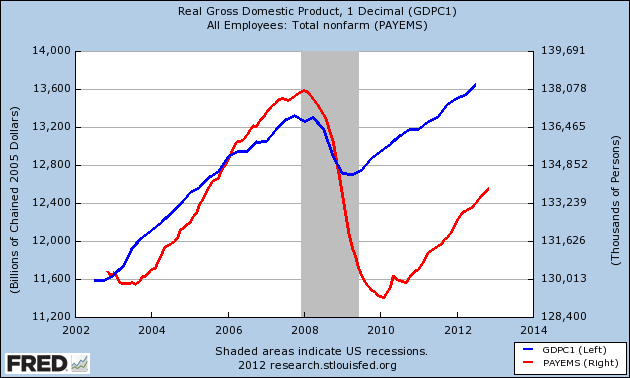
GDP to record levels yet employment down by 4 million.

Our Gross Domestic Product is now at record levels yet we are doing this with over 4 million workers less than in 2007:

gdp and nonfarm workers

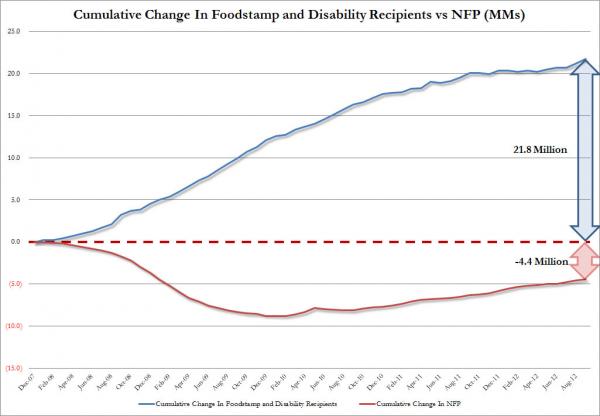
The reason this is possible is that income inequality is simply growing more dramatically. That is why on one side of the spectrum we see big financial institutions back to making big bets and earning big bonuses while in the last month of data, we added 600,000 more Americans to the food stamp system. If you want to visualize how things have played out since the recession began here is an excellent chart:

Cumulative SNAP and Jobs

So if you were following the trends since the recession hit you would find the following information:
Food stamp usage: up by over 21.8 million
Employment: 4.4 million below the point where the recession officially started
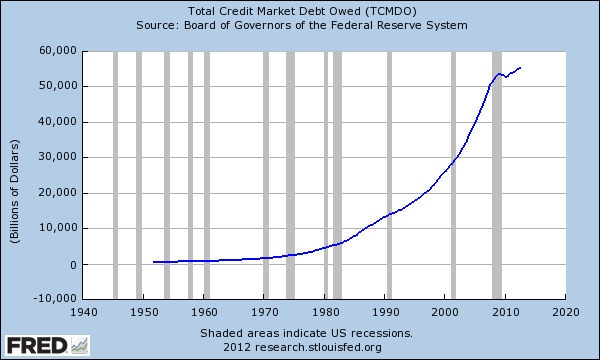
These figures are important. You might be asking how this occurring in a supposed recovery. A large part of this growth is being juiced up by massive debt programs and pseudo-debt and money creation programs like QE3:

total credit market debt

The total US credit market debt is at a record $55.3 trillion. We are inching closer to blowing right through another debt ceiling and the fiscal cliff is not a shocking surprise, it is merely the culmination of massive debt addiction stemming back to the 1970s. Yet as many countries are now facing including many in Europe, there is a point of debt saturation. Inequality reaches a major tipping point especially when you eat away at your middle class. Are all those people on food stamps buying iPads and purchasing new cars? Unlikely. If they are, some are doing it via debt that they clearly cannot afford.


Food stamp nation.

Food stamps have essentially kept 1 out of 6 Americans from being out on the streets and starving:

Foodstamps oct 2012

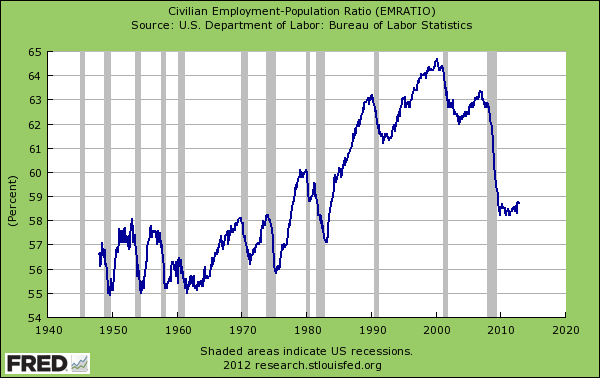
Yet a recovery this is not and the 7.8 percent headline unemployment rate is largely driven by the dwindling workforce participation:

civilian pop ratio

The above is a better indicator of the percent of Americans actually working. As you can see, it is hard to see an actual recovery. You have to ask deeper questions like what are those 500,000 people that dropped out of the labor force now doing. What propelled 600,000 people to suddenly enter the food stamp program and push the overall figure to 47.7 million? The data is readily available yet no one in the mainstream press covers this because in all honesty, the mainstream press is a vehicle to sell advertising. So of course they have a vested interest in keeping the story going that all is well and people should go out and spend (another reason why 1 out of 3 Americans has zero saved to their name). Just look at the ads they have. You think telling the public that 1 out of 6 Americans are scraping by in poverty with food stamps is going to sell more cars?
Debt is not wealth. Food stamps are not a sign of positive economic growth. You would think this would be common sense but as we approach another debt ceiling, the Fed is trying to inflate a housing bubble again, and as we confront the fiscal cliff you realize that we are back to old habits.Hmmmm....."Together We Thrive"Read the full story here.
Wednesday, November 21, 2012

More Americans Will Use Food Stamps For Thanksgiving This Year Than Ever Before.


More Americans Will Use Food Stamps For Thanksgiving This Year Than Ever Before.(USNews).By .More Americans will use food stamps to buy their Thanksgiving dinner this year than ever before, according to a new report from the nonprofit government watchdog group The Sunlight Foundation.
The Food Stamp Challenge, which challenges higher-income families to live as if they are on food stamps, estimates that a person on food stamps has a budget of about $1.25 per meal.
In other words, a family on food stamps must buy an entire meal per person for less than the cost of an average cup of coffee.
Usage of food stamps among low and no-income families has spiked since the collapse of the U.S. financial system four years ago. According to the U.S. Department of Agriculture, average participation in the Supplemental Nutrition Assistance Program, or food stamp program, has increased 70 percent since 2007. And economists have warned that usage of food stamps won't go down until unemployment improves.
This Thanksgiving, 42.2 million Americans will be on food stamps, according to the Economic Policy Institute. This is roughly the size of the populations of California and Connecticut combined.
Not surprisingly, feeding millions of Americans isn't cheap. The cost of the SNAP program last year reached $72 billion, the highest to date, according to the Congressional Budget Office.The farm bill, which directs the nation's food policy, devotes about 80 percent of its budget to the food stamp program.Hmmmm....Get ready to say thanks for another Four years of Obama.Read the full story here.
Related:  US overtakes Europe to become biggest importer of Chinese goods

Thursday, November 15, 2012

Food Stamp Recipients Alone Would Have Accounted For 75% Of Obama’s Total Vote.


Food Stamp Recipients Alone Would Have Accounted For 75% Of Obama’s Total Vote.(CNS).If all 47 million food stamp recipients voted for President Obama, it would account for 75.4 percent of Obama’s 62.3 million votes.
Harry Hopkins, FDR’s close adviser who ran the non-defunct Works Progress Administration (WPA), once described Roosevelt’s strategy as “tax & tax, spend & spend, elect & elect.” He believed that if Roosevelt put everyone on the federal payroll, either through aid or federal jobs, that Roosevelt would never lose. FDR won four presidential elections in a row before his death removed him from office.
Did Obama use his idol’s model to win this election?
Food stamps rolls have grown by nearly 50 percent-by more than 15 million recipients-under the Obama administration. During that same time, the unemployment rate has stayed the same. Either those outside of the workforce have been decimated by the Obama economy or this administration is making a conscious effort to get more Americans reliant on government. Or both.
If citizens vote in their own personal, short-term interests, with 49 percent of the population receiving some sort of federal aid, Republicans will never win another election. Thankfully many of those 49 percent are elderly voters who want a bright, debt-free future for their children.Hmmmm........Talk about a 'Voters base'.Read the full story here.
Wednesday, November 14, 2012

Ohio food stamps for low income families will be reduced in January 2013.


Ohio food stamps for low income families will be reduced in January 2013.(EX).The Toledo Blade reported on Monday that the state Department of Jobs and Family Services will begin reducing food stamps for Ohio residents beginning in 2013. Reduction estimates should total $50 per family which is about $520 million worth of yearly groceries from a total of 869,000 households. 
Blame it on the change in weather and the extra warm winter Ohio residents had last year. The effects of that mild winter caused residents to have lower utility bills thereby reducing the overall natural gas usage. According to the Department of Jobs and Family Services this reduced the standard utility allowance that is factored in when determining a person's eligibility for food stamps. This amount was determined by the federal department and Ohio can do nothing to change the outcome. “This is a federal issue,” said Joel Potts, executive director of the Ohio Department of Job and Family Services Directors’ Association. “It is what it is. They have a formula. ... We just think it is going to be really hard on families and individuals. They will see significantly less money starting in January.” 
The unfortunate outcome in Ohio families having their stamps cut is that they will have even less money to spend on food. There are already a number of families that rely on visiting food banks because their food stamps often run out by month's end. Parents with children who suffer from food allergies have to be critical of certain food items. This means that their grocery bills are often higher than the average family. Because the Ohio Department of Job and Family Services will lower food stamps in January it may be even more difficult for them to buy the right type of groceries. Fifty dollars may seem like a small amount to some, however, most low income families who look forward to this every month will find difficult to manage. It's more important than ever to find ways to lower costs for groceries in order to get the foods you need for your family. One of the best ways to counteract these cuts is to look for coupons online and in the daily paper and you may even find it necessary to visit local food banks.Read the full story here.
Related Posts Plugin for WordPress, Blogger...