

Showing posts with label copyright infringement. Show all posts
Showing posts with label copyright infringement. Show all posts
Sunday, July 13, 2014
Video - "Pallywood presents" - Hamas propaganda uses Hollywood's 'Final Destination4'
Hmmmm......I wonder if the FBI will react to this copyright infraction?

Tuesday, October 22, 2013

Monday, October 21, 2013
ObamaCare enrollees to join president in Rose Garden.

ObamaCare enrollees to join president in Rose Garden.HT: TheHill.
President Obama "will directly address the technical problems" with the ObamaCare website during a Rose Garden event Monday morning, according to a White House official.
The president will discuss work continuing "around the clock" to improve the website, which has been plagued by problems since its launch earlier this month. According to the White House official, the president and his team find those troubles "unacceptable."
The official said the president will be joined by "consumers, small business owners, and pharmacists," including individuals who have already enrolled in ObamaCare online.
Many individuals have reported issues creating accounts on the website, which allows uninsured Americans to shop for health insurance. Healthcare providers have also complained that the government has turned over error-riddled data for those Americans who are able to successfully purchase coverage on the exchange.
Lawmakers from both sides of the aisle have expressed outrage with persistent problems.
The House Energy and Commerce Committee plans to hold a hearing on the website's issues during the week.
On Sunday, House Minority Leader Nancy Pelosi (D-Calif.) said the issue "has to be fixed."
Republican National Committee Chairman Reince Priebus and Sens. Ted Cruz (R-Texas) and Pat Roberts (R-Kansas) have called for the resignation of Department of Health and Human Services Secretary Kathleen Sibelius over the issues.
In a blog post on Sunday, HHS said it had called in "some of the best and brightest" to help iron out the technical glitches.
“We have updated the site several times with new code* that includes bug fixes that have greatly improved the HealthCare.gov experience,” the agency said. “Today, more and more individuals are successfully creating accounts, logging in, and moving on to apply for coverage and shop for plans. We're proud of these quick improvements, but we know there's still more work to be done.”
The White House said the president will also stress that the Affordable Care Act is "much more than just a website" in the event.
According to the White House, there have been more than 19 million unique visits to the website since its launch this month. And an administration official said Saturday that nearly a half million Americans have begun shopping for insurance on the site, although the White House did not announce how many of this individuals had successfully purchased coverage. Read the full story here.
Update: AP White House Reporter: WH Stonewalling on Enrollment Figures
Related: * Obama admin caught in blatant software piracy; script powering Healthcare.gov ripped off from UK company.

Saturday, October 19, 2013
Obama admin caught in blatant software piracy; script powering Healthcare.gov ripped off from UK company.

Obama admin caught in blatant software piracy; script powering Healthcare.gov ripped off from UK company.HT: NatNews.
The Obama administration has been caught red-handed engaged in software piracy. Computer code used on Healthcare.gov was stolen (and then modified in an effort to conceal the theft) from a UK company called Spry Media.To my best knowledge, this story was broken by WeeklyStandard.com in a blog authored by Jeryl Bier.The computer code that was stolen is called DataTables, and it is exclusively provided under a GPL v2 license which requires anyone who uses the software code to keep the copyright notice visible in the code itself. This allows the original author of the code to receive attribution for creating it.An analysis of the code running Healthcare.gov reveals that the Obamacare development team maliciously removed the copyright notice and credit attributions from the code while copying and using the rest of the code. In the field of journalism, this would be called “plagiarism.” In the field of computer software, it’s called “piracy” according to the U.S. government.Here’s an image capture of the copyright notice which is supposed to remain in the code:
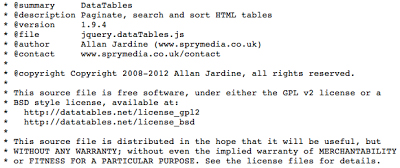
On Healthcare.gov, however, the copyright attribution is removed, leaving only the functional code of the script (which is a piracy violation):
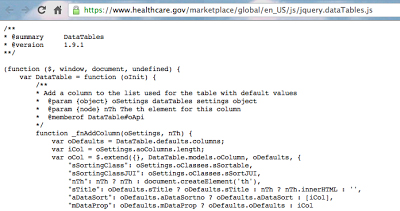
Nearly all of the remainder of the script is identical to the Spry Media code, proving beyond any doubt that the Obama administration pirated this code in its construction of the failed website Healthcare.gov.The Weekly Standard says they contacted SpryMedia for a comment: “A representative for the company said that they were ‘extremely disappointed’ to see the copyright information missing and will be pursuing it further with the Department of Health and Human Services, the agency that runs the Healthcare.gov site.”Will DHS now seize Healthcare.gov?The Department of Homeland Security has seized hundreds of other websites that it says were engaged in piracy.
Willful copyright infringement is a federal crime that carries penalties for first time offenders of up to five years in federal prison, a $250,000 fine, forfeiture and restitution.
Will the developers of Healthcare.gov who pirated the DataTables software from SpryMedia now be sentenced to federal prison?Read the full story here.
Sunday, August 25, 2013
Creative Commons founder Larry Lessig threatened with copyright infringement.

Creative Commons founder Larry Lessig threatened with copyright infringement.
 Larry Lessig Threatened With Copyright Infringement Over Clear Fair Use; Decides To Fight Back (via Techdirt)
If you read Techdirt, you're almost certainly familiar with Larry Lessig, the law professor at Harvard who (among many other things) has been an avid advocate for copyright reform and campaign finance reform, an author of many books about copyright…
Friday, December 21, 2012
‘End of the road’ for ACTA in Europe as EC withdraws court appeal over treaty.

‘End of the road’ for ACTA in Europe as EC withdraws court appeal over treaty.(RT).The European Commission has withdrawn its request to review ACTA’s compatibility with the EU law in the European Court of Justice. The move virtually ensures the treaty will never be adopted in the Union.
Monday, December 3, 2012
Net Neutrality? Google Prods Users to Fight Copyright Law

Net Neutrality? Google Prods Users to Fight Copyright Law.(Spiegel).By Sven Becker and Marcel Rosenbach. Google is increasingly throwing around its power to improve its bottom line. The latest incident is a draft law in Germany that would force the company to share some revenues with newspaper publishers. Meddling in politics is certainly not illegal, but it could be risky.
At its core, the proposal concerns the headlines and short teaser texts indexed by search engines -- the so-called snippets.
The bill aims to protect copyrights that belong to newspapers and their publishers. When search engines display those snippets "for commercial purposes," the proposed law would allow the publishing houses to charge a fee. Bloggers, clubs, associations and even company press reviews would not be affected by the current draft version of the law.
Until last week, this somewhat arcane issue in copyright law caused little more than a ripple in the public consciousness.
But all that changed on Tuesday. That's when Google declared the skirmish over the info snippet as a major battleground in the big war -- namely the fight for freedom on the Web. Consequently, the roughly 15.6 million users who bombard Google Germany with search queries every day were presented with a link under the usual search mask that led them directly to a campaign website -- where the search engine giant called for resistance: "Defend Your Net." According to Google, the law would "make it significantly more difficult to find the information you are searching for on the Internet." Read the full story here.
Monday, October 15, 2012
Canada-EU Trade Agreement Replicates ACTA’s Notorious Copyright Provisions.

Canada-EU Trade Agreement Replicates ACTA’s Notorious Copyright Provisions.(EFF).By Carolina Rossini.The shadow of the Anti-Counterfeiting Trade Agreement (ACTA) is back in Europe. It is disguised as CETA, the Canada-European Union and Trade Agreement. As reported by EDRI, a rather strange and surprising e-mail was sent this summer from the General Secretariat of the Council of the European Union to the Member States and the European Commission. The e-mail explained that the criminal sanctions provisions of the draft CETA are modeled on those in ACTA.
A comparison of the leaked draft Canada-EU agreement shows the treaty includes a number of the same controversial provisions, specifically concerning criminal enforcement, private enforcement by Internet Service Providers (ISPs), and harsh damages. These provisions are particularly problematic, and were the key reasons why the European Parliament rejected ACTA.
However, given the lack of transparency associated with the CETA discussions (both Canada and EU insist that the draft text remain secret), the concerns that CETA may replicate ACTA appear to be very real despite denials from some members of the European Commission.
CETA is a trade agreement designed to strengthen economic ties between Canada and the EU through “free” trade and increased investment. However, hidden within this treaty are provisions that were essentially lifted from ACTA word-for-word. And just like its close cousins, ACTA, KORUS, and TPP—and other trade agreements that are applauded by the entertainment industry for carrying expansive intellectual property provisions—CETA is being negotiated in secret.
Jérémie Zimmermann declared:
The only hard evidence on which we can base our analysis suggests the worst: once again, the European Commission and the EU Member States governments are trying to impose repressive measures against cultural practices online. (…) This trend of sneaking repressive measures through negotiated trade agreements must stop.This cut-and-paste strategy was confirmed yesterday by La Quadrature du Net, which had representatives present in a workshop on October 10th, where Philipp Dupuis, the European Commission negotiator, bragged that ACTA-like criminal sanctions were still in the CETA draft. Following the workshop, La Quadrature du Net sent letters to Mr Pierre Moscovici, Minister for Economic Affairs and Finance, requesting clarifications and demanding that the criminal measures be removed from CETA.
The 92% of the European Union Parliament who voted against ACTA in July 2012 demonstrated that the EU was overwhelmingly against provisions like this, and many expected that it would be the end of the matter. Sadly, that assumption appears to have been unfounded. Despite this there are encouraging signs of resistance—including that the Dutch government has stated that it would not accept CETA moving forward this way.
Civil society, which has mobilized and filled streets of France, Poland, and others, is calling on citizens to demand that their governments remove copyright provisions from CETA during the upcoming round of negotiations next week in Brussels.
The Consolidation of Policy Laundering and Increasing Secrecy in International Negotiations
The copyright lobbies have consolidated on the use of foreign and international forums as an indirect means of pushing policies—a strategy known as policy laundering—like those ones in CETA that might never win direct approval through the regular domestic political. The move from fora like the World Intellectual Property Organization (WIPO) or the World Trade Organization (WTO) to bilateral and regional trade agreements confirms it. Policy laundering takes advantage of the fact that the institutions nations have created for ensuring democratic control and input into the bureaucratic policymaking process have not yet been instituted into most international bodies and negotiation venues. And of course, the entertainment lobby applauds this. It is well known for instance, that provisions of the US DMCA were the result of policy laundering. This should not be the way we build 21st century agreements.
International negotiations are abstract and it’s hard to see how they may eventually affect one's life. When a trade agreement or treaty is signed by a country and later ratified however, it does manifest itself into national law. Therefore, the time to act is from the very beginning of such initiatives, not later. Secrecy around negotiations is not democratic, violates the open government principles many of the negotiating countries have signed onto, and purposefully makes taking action much more difficult.
Secrecy impacts civil society’s ability to comment or analyze agreements, just as it does with the Trans-Pacific Partnership agreement (TPP) and other FTAs. It’s hard enough to work within the participation system at places like WIPO, but at least there we are given some opportunity to observe and participate in the official discussions. When trade negotiators and copyright maximalists get together to launder IP rights expansion through secret agreements, we lose that small but vital voice that lets us speak truth to power.
Additional Resources:
Europe: La Quadrature du Net: http://www.laquadrature.net/en/CETA
Europe: EDRI http://www.edri.org/edrigram/number10.17/ceta-acta-criminal-sanctions
Canada: Michael Geist blog on ACTA http://www.michaelgeist.ca/index.php?option=com_tags&task=view&tag=acta&Itemid=408
Tuesday, October 9, 2012
"Happy New Year" - Major Internet service providers to institute so-called six-strikes plan by year’s end.

"Happy New Year" - Major Internet service providers to institute so-called six-strikes plan by year’s end.(Wired).
The nation’s major internet service providers by year’s end will institute a so-called six-strikes plan, the “Copyright Alert System” initiative backed by the Obama administration and pushed by Hollywood and the major record labels to disrupt and possibly terminate internet access for online copyright scofflaws.The plan, now four years in the making, includes participation by AT&T, Cablevision Systems, Comcast, Time Warner Cable and Verizon. After four offenses, the historic plan calls for these residential internet providers to initiate so-called “mitigation measures” (.pdf) that might include reducing internet speeds and redirecting a subscriber’s service to an “educational” landing page about infringement.
The internet companies may eliminate service altogether for repeat file-sharing offenders, although the plan does not directly call for such drastic action.
“We are farily confident the program will launch by year’s end,” said Jill Lesser, the executive director of the Center for Copyright Information, the name of the group behind the program.
The program, which monitors peer-to-peer file-sharing services, was to have been deployed sooner, according to Gigi Sohn, president of digital rights group Public Knowledge, and an adviser to the center.
Sohn noted that the internet was aflame in January with federal anti-piracy proposals — the Stop Online Piracy Act and the Protect IP Act — both of which went down in flames amid a huge backlash and internet blackout.
Top-ranking Obama administration officials, including the U.S. copyright czar Victoria Espinel, played an active role in secret negotiations between Hollywood, the recording industry and ISPs to disrupt internet access for users suspected of violating copyright law, according to internal White House e-mails.
The e-mails, obtained via the Freedom of Information Act, show the administration’s cozy relationship with Hollywood and the music industry’s lobbying arms and its early support for the copyright-violation crackdown system publicly announced in July, 2011.
Under the six-strikes plan, internet subscribers may challenge their dings for a $35 filing fee paid to an arbitration service. They also get a free pass, one time, if they claim the infringement was based on having an open, unencrypted Wi-Fi network.
France has a much more stringent plan. Last month, the nation levied its first fine, $193, under its three-strikes plan.Read the full story here.
The e-mails, obtained via the Freedom of Information Act, show the administration’s cozy relationship with Hollywood and the music industry’s lobbying arms and its early support for the copyright-violation crackdown system publicly announced in July, 2011.
Under the six-strikes plan, internet subscribers may challenge their dings for a $35 filing fee paid to an arbitration service. They also get a free pass, one time, if they claim the infringement was based on having an open, unencrypted Wi-Fi network.
France has a much more stringent plan. Last month, the nation levied its first fine, $193, under its three-strikes plan.Read the full story here.
Tuesday, May 22, 2012
U.S. Six Strikes Copyright Infringement Scheme Delayed Again

U.S. Six Strikes Copyright Infringement Scheme Delayed Again.(GP).And it's one, two, six strikes you’re out at the old ball game - but the ball game has been delayed. And when I say ballgame, I mean the agreement between rights holders in the United States and Internet service providers which would institute a "six strikes" system for those naughty people that infringe on copyrights while using the Internet...
In an undetermined (at this point) number of months, the Center for Copyright Information (CCI) will begin the process of tracking down copyright infringers as part of an agreement all major U.S. Internet providers struck with the MPAA and RIAA. All of the parties involved eventually agreed to a system where copyright infringers would receive a series of warnings from their service providers telling them that that their behavior is unacceptable and would offer some form of "education" to show those individuals the error of their ways. After six warnings ISPs can decide what kind of action to take against repeat offenders including slowing down connections or temporary disconnections.
The agreement was called "Copyright Alerts" when it was revealed in July of last year and some ISPs were expected to send out the first warnings before the end of 2011. But something happened and that deadline passed by without a peep from all involved. The one thing that was revealed was that there was a new deadline: July 1, 2012, but it looks like that one will be missed too.
Web site TorrentFreak recently asked the CCI about the upcoming target date:
"The dates mentioned in the Memorandum of Understanding (MOU) are not hard deadlines but were intended to keep us on track to have the Copyright Alert System up and running as quickly as possible and in the most consumer friendly manner possible," a spokesperson told the publication. "We do not intend to launch until we are confident that the program is consumer friendly and able to be implemented in a manner consistent with all of the goals of the MOU. We expect our implementation to begin later this year."
The CCI went on to tell the publication that the group has selected a third-party company that will be responsible for monitoring BitTorrent swarms, but did not reveal the name of that company.
"The technology partner we have identified and begun working with is an independent and impartial expert and we expect to have an announcement about the independent expert shortly," TorrentFreak was told.
This could be why the six strikes plan has been delayed, because the unnamed technology partner is being doubly scrutinized to make sure their data collection methods are accurate.Read the full story here.
Subscribe to:
Posts (Atom)
