Showing posts with label Russian Mediterranean fleet. Show all posts

Friday, September 13, 2013

Russia's destroyer Smetlivy departs from Sevastopol to Syrian waters.


Russia's destroyer Smetlivy departs from Sevastopol to Syrian waters.(RBTH).

The Russian Black Sea Fleet destroyer Smetlivy has departed from the fleet's main base of Sevastopol to accomplish missions in the eastern Mediterranean, a military diplomat told Interfax-AVN on Thursday.
"The Smetlivy under command of Capt. 2nd Rank Andrei Zaitsev departed from Sevastopol this morning and headed for the Bosporus Strait. The destroyer will pass through Black Sea straits together with the large landing ship Nikolai Filchenkov that left Novorossiysk the day before. The Black Sea Fleet's ships will be accomplishing combat missions off Syria under a plan from the Navy operative command," the source said.

The Smetlivy, which marked its 44th anniversary in June, returned to base in February after a 111-day combat duty in the Mediterranean Sea. It spent three months in a dock for repairs.

Destroyer brigade staff chief Capt. 1st Rank Pavel Yasnitsky has been appointed as the voyage superior.

The Smetlivy of Project 61 has a displacement of 4,460 tons. It is armed with X-35 "Uran" anti-ship missiles, an AK-726 artillery system, a 16-missile Volga air defense system, a 1x5 533-millimeter torpedo launcher (five torpedoes) and two RBU-1000 anti-submarine and anti- torpedo rocket launchers.

The frigate Admiral Panteleyev, the destroyer Neustrashimy and the large landing ships Alexander Shabalin, Admiral Nevelskoy, Peresvet, Novocherkassk and Minsk are accomplishing plans of the operative command in the Mediterranean Sea. The SSV-21 Priazovye medium-sized reconnaissance ship is operating under separate plans of the General Staff.

Russia will increase its group in Mediterranean - commander-in-chief of Russian Navy.


Russia will increase its group in Mediterranean - commander-in-chief of Russian Navy.(RBTH).

The Russian Navy will continue resolving problems where threats to Russia's national security arise, including in the Eastern Mediterranean, Admiral Viktor Chirkov, commander-in-chief of the Russian Navy, told reporters on Friday.

"The Navy will increase its group in the Mediterranean until it becomes self-sufficient and can deal with issues relating to the completion of certain tasks. The tasks are very clear: to deter the slightest threat to Russian borders and the security of the state. It's common practice for all fleets of the world to be present in places where tensions are rising," Admiral Chirkov said.

The admiral also said that the Russian fleet began increasing its group in the Mediterranean last year in view of the military and political situation there. In December 2012, the Russian Navy began maintaining a permanent naval presence in the Eastern Mediterranean.

Chirkov said that the operative command in area was created to improve the management of forces fulfilling tasks in the Mediterranean.

According to the plan of this command, the permanent operative junction of the Russian Navy now is comprised of the large landing ships Peresvet, Admiral Nevelsky, Minsk, Novocherkassk, Alexander Shabalin, the large destroyer Admiral Panteleyev, and the guard ship Neustrashimy. The group will also include the guard missile cruiser Moskva, the guard ship Smetlivy, and the large landing ship Nikolai Filchenkov. More here.

Wednesday, September 4, 2013

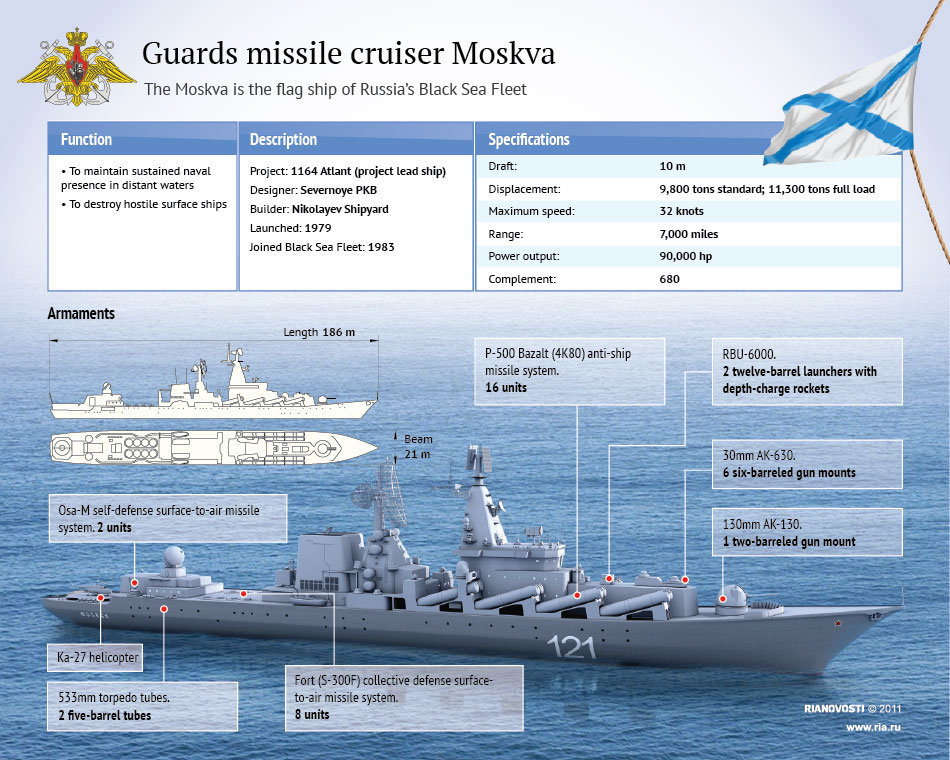
The Black Sea Fleet rocket cruiser Moskva is heading to the eastern Mediterranean.

Cruiser 'Moskva'.

The Black Sea Fleet rocket cruiser Moskva is heading to the eastern Mediterranean.(VOR).

The Black Sea Fleet rocket cruiser Moskva is heading to the eastern Mediterraneaninstead of visiting the port of Mindelo, Cape Verde, which was scheduled earlier, a military-diplomatic source in Moscow said on Wednesday.

"The plans of the naval unit under the command of Rear Admiral Valery Kulikov had to be changed a little. Instead of visiting a Cape Verde port, the cruiser Moskva heads to the Strait of Gibraltar. In about ten days, it will enter the eastern Mediterranean, where it will replace the destroyer Admiral Panteleyev as the flagship of the operative junction of the Russian Navy," the source said. The naval unit's plans were made back in 2012, the source said.

"That ocean voyage stopped playing its military and political role after the demise of Venezuelan President Hugo Chavez. However, it was valuable practice for the Russian fleet," the military diplomat said. Voice of Russia, Interfax.

YesterdayOur prediction: the next ship to be dispatched in direction Syria will be the missile cruiser Moskva, the “flag ship of the Black Sea fleet” and more of its affiliated warships, which was last deployed in November of 2012 during the 8 day escalation between Israel and Gaza which culminated in Operation Pillar of Defense. That, and a whole lot of submarines.

Tuesday, September 3, 2013

Russia Sends Two Marine-Carrying Ships To The Mediterranean

Admiral Panteleyev.

Russia Sends Two Marine-Carrying Ships To The Mediterranean (ZeroHedge, Sep 3, 2013):
If the direct result of today’s surprising and unannounced Israeli missile test was to provoke a response by Russia, the Allies have succeeded. ITAR TASS reports that Russia’s Black and Baltic Sea Fleets’ Ropucha-class landing ships Novocherkassk (150 marines on board) and Minsk (225 marines) have sailed off for the Mediterranean Sea. What was not reported is that the destination of the two marine carrying ships is the sensitive area around Syria already staked out by the US navy. It is implied.
“The Russian Navy continues stage-by-stage rotation of warships and support ships of the standing naval force in the Mediterranean,” the spokesman said. “Having passed through the Bosporus and Dardanelles straits, the big landing ships will reach the designated area in the Mediterranean Sea on September 5 or 6 to start their mission under the command of the remote zone headquartered onboard the big anti-submarine ship of the Russian Pacific Fleet Admiral Panteleyev.”
Currently, one of the key tasks of the Russian standing naval force in the Mediterranean is “comprehensive monitoring over the air, underwater and surface situation in the zone of its deployment,” the Russian defence ministry said, adding that the rotation of Russian warships in the Mediterranean Sea would continue till mid-September.
In other words, more ships will be “rotating” into the Mediterranean for the next two weeks. The last time Russia dispatched one or more squadrons of ships to Syria was last December, when Syria was once again a hot bed of pre-war foreplay. This is what Russia did back then: “The squadron of five ships that sailed from the Baltic Sea base of Baltiysk includes a destroyer, a tugboat, a tanker and two large amphibious vessels that could evacuate hundreds of people… Another group of three navy ships departed Tuesday from Severomorsk, the main base of Russia’s Northern Fleet on the Kola Peninsula.” Will Russia repeat a comparable pile up of naval powers now as it did then? Most certainly.
Summarizing the balance of power so far:
  • 2 US amphibious assault ships are about to be matched by 2 Russian amphibious assault ships. That’s a lot of marines.
  • The US still outnumbers Russia with 5 destroyers including 4 from the strike group surrounding the USS Nimitz carrier which is also slowly approaching Syria.
Our prediction: the next ship to be dispatched in direction Syria will be the missile cruiser Moskva, the “flag ship of the Black Sea fleet” and more of its affiliated warships, which was last deployed in November of 2012 during the 8 day escalation between Israel and Gaza which culminated in Operation Pillar of Defense. That, and a whole lot of submarines.
Finally, for those curious or simply “mocking” Russia’s navy, here is a full breakdown of just the Russian Black Sea fleet currently:
And a snapshot of the entire current Russian Navy as of August:

Saturday, June 29, 2013

Iran, Russia plan joint naval exercise in Caspian Sea: Russian cmdr.


Iran, Russia plan joint naval exercise in Caspian Sea: Russian cmdr.(PressTV).
Deputy Commander of Russia’s Caspian Flotilla Nikolai Yakubovsky announced the news after a Friday meeting with the commander of Iran’s naval fleet that has been dispatched to the Russian port city of Astrakhan, RIA Novosti reported.

In 2009, the two countries conducted their first joint naval maneuvers in the Caspian Sea, involving about 30 vessels.

Iran has dispatched two indigenously-built missile-launching warships to Astrakhan in a move to consolidate friendly relations between Tehran and Moscow.

During the Iranian naval fleet’s stay at Astrakhan Port, the Iranian naval officers will visit some military and port facilities in Russia and hold meetings with a number of high-ranking Russian commanders and officials.

On April 21, a group of Russian Navy warships docked at the southern Iranian port city of Bandar Abbas after a long journey from the Pacific Ocean.

The fleet, which comprised Admiral Panteleyev anti-submarine destroyer and the logistic battleships Peresvet and Admiral Nevelskoi vessel with a crew of 712, entered the Iranian naval zone in a bid to further strengthen relations between Tehran and Moscow and promote bilateral naval cooperation to maintain maritime security.

In recent years, Iran’s Navy has been increasing its presence in international waters to protect naval routes and provide security for merchant vessels and tankers.

The Islamic Republic has repeatedly asserted that its overseas naval presence is meant to convey a message of peace and friendship to other countries. Hmmmm.......Ok Ahmed we shoot...you sink....ponemai?Read the full story here.

Thursday, May 16, 2013

"CHANGE" - Russian warships enter Mediterranean to form permanent task force.

Adm Panteleyev

"CHANGE" - Russian warships enter Mediterranean to form permanent task force.(RT)
The task force has successfully passed through the Suez Channel and entered the Mediterranean. It is the first time in decades that Pacific Fleet warships enter this region,” the Pacific Fleet spokesman, Capt. First Rank Roman Martov told RIA.
The vessels are now heading to Cyprus and will make a port call in the city of Limassol, he added. 
The group includes destroyer “Admiral Panteleyev,” two amphibious warfare ships “Peresvet” and “Admiral Nevelskoi,” as well as a tanker and a tugboat. 
The ships left the Far-Eastern port city of Vladivostok on March 19 to join Russia’s Mediterranean task force, which currently consists of vessels from Northern, Baltic, and the Black Sea Fleets, including a large anti-submarine ship, a frigate and a Ropucha-II Class landing ship.

Russian Navy Commander Adm. Viktor Chirkov on Sunday announced plans for the Mediterranean task force and said that it may “possibly” be enlarged to include nuclear submarines. “Overall, already from this year, we plan to have 5-6 warships and support vessels [in the Mediterranean Sea], which will be replaced on a rotating basis from each of the fleets – the Black Sea, Baltic, Northern and, in some cases, even the Pacific Fleet.

Depending on the scope of assignments and their complexity, the number of warships in the task force may be increased,” Chirkov said, as quoted by RIA. Russian submarines may be deployed in the region “in perspective,” the Navy Commander said, reminding that both nuclear and diesel submarines were present in the Soviet Union’s 5th Mediterranean Squadron. “Everything will depend on the situation,” Chirkov said, also leaving the door open for missions in the Atlantic and Indian Oceans.

The task force will be “comprehensively trained” to meet situations that may arise in these regions too, he said. The Russian Defense Ministry announced setting up a naval task force in the Mediterranean in April, while the country’s Defense Minister Sergey Shoigu has said a permanent naval task force was needed to defend Russia’s interests in the region.

The permanent fleet’s headquarters will be set up in the summer of 2013, although their actual location is yet to be announced.

The Mediterranean has recently become a hotspot of military muscle flexing as global powers seemingly vie for influence.
NATO has been staging major naval war games involving several countries, last October holding an exercise code-named Noble Mariner 12. Russia held its largest naval exercises in the region this January, with drills spanning both the Black and Mediterranean Seas. The media quickly linked both the NATO and Russian war games to the situation in Syria.

Another recent naval display, seen as provocative by Israel, was the deployment of the Iranian Navy’s 24th fleet to patrol the Mediterranean and convey a “message of peace.” Since then, Israel has acquired its fifth Dolphin-class submarine allegedly capable of launching cruise missiles with nuclear warheads.

China has also been increasing its involvement in the area, with the country’s warships sailing through the Suez Canal, and several key ports of the region becoming partially China-owned.

Major naval groups serving in the Mediterranean Sea include NATO’s Standing Maritime Group 2, French Naval Action Force, and the US Navy 6th Fleet. The only Russian naval installation in the region has for decades been the maintenance facility in the Syrian city of Tartus.Hmmmm.....I think this could pass as an 'answer' to pres Obama's letter to Pres Putin.Read the full story here.

Related: Russian Navy Chief Adm. Viktor Chirkov: Russia's Mediterranean Task Force to Include Nuclear Subs

             Russian Warships will continuously Patrol Syrian Coast
Related Posts Plugin for WordPress, Blogger...