

Showing posts with label The make-believe presidency. Show all posts
Showing posts with label The make-believe presidency. Show all posts
Tuesday, January 5, 2016

Iran Transfers Batch of Emad Missiles to New Underground Missile base.

Iran Transfers Batch of Emad Missiles to New Underground Missile base. (Fars).
Iranian Parliament Speaker Ali Larijani made a visit to the Islamic Revolution Guards Corps (IRGC)'s new underground missile town today during which he vowed the legislature would allocate a much bigger budget to the country's missile program.
The Images and footages released after the visit indicated that the IRGC has transferred a large number of Emad missiles to the deep underground base.
It is the second underground missile town that Iran is displaying in the past few months.
Iran in October unveiled a deep underground tunnel facility packed with missiles and launcher units a few days after testing the long-range Emad missile.
After unveiling the underground depot for the first time, IRGC Lieutenant Commander Brigadier General Hossein Salami said, "That was one of our oldest stockpiles and we haven’t yet shown our modern missile depots, where missiles with big cross sections have been stockpiled."
Also in November, a senior advisor to the IRGC Quds Force commander announced that Iran is in possession of 14 missile depots in the depth of 30m to 500m under the ground in different parts of the country that are equipped with automatic launchers.
"The Islamic Republic of Iran has 14 underground depots in the depth of 30m to 500m," Brigadier-General Karimpour said.
He warned that any country that dares to attack Iran will be riddled with missiles fired from these depots in large numbers automatically.


Monday, December 28, 2015
Iran’s IRGC supplied with disputed Emad ballistic missile.
Iran’s IRGC supplied with disputed Emad ballistic missile. (Taz).
Iran’s Islamic Revolutionary Guards Corps (IRGC) has received the new homemade ballistic missile, Emad, the deputy IRGC Commander, Brigadier General Hossein Salami said.
Without giving any details, Salami said that the Emad missile (updated version of the Qadr missile) may be used in the upcoming IRGC military drill, Fars news agency reported Dec. 28.
Last October Iran test fired Emad missile, capable of carrying a nuclear warhead, which raised disputes about possible violations of UN Security Council resolutions.
The missile meets the minimum requirements for delivering nuclear weapons (500 kilogram payload over 300 kilometers).
The Emad is the latest generation of Iran’s long-range ground-to-ground ballistic missiles, capable of guidance and control technologies to assure intended targets are struck, according to the Iranian officials.
The missile’s engine operates on liquid fuel and its range reaches 1700 kilometers, while the Islamic Republic insists on calling Emad a long-range missile.
Under international restrictions, Iran has turned to domestic talents to improve its military power, frequently unveiling new products.
As a result of the embargo, Iran’s military capability is drastically limited, compared to US and NATO forces. Hmmm..........Test fired half October and already operational?
Related: Iran tests new precision-guided ballistic missile Emad would have a range of 1,700 km (1,060 miles).
More on the missile capability of Iran can be read here and here.
Saturday, November 14, 2015
Iran discloses range of recently tested Emad ballistic missile.

Iran discloses range of recently tested Emad ballistic missile. (Taz).
Iran has unveiled the range of its newly tested ballistic missile, which raised disputes about possible violations of UN Security Council resolutions.
General Amir Ali Hajizadeh, commander of the Islamic Revolutionary Guard Corps (IRGC) Aerospace Force, announced that the range of the Emad ballistic missile, which was successfully test-fired in mid-October, reaches 1700 kilometers, the semi-official Fars news agency reported Nov. 14.
The Emad is the latest generation of Iran’s long-range ground-to-ground ballistic missiles, capable of adding guidance and control technologies to assure intended targets are struck, according to the Iranian officials.
The missile’s engine operates on liquid fuel. Although the Islamic Republic insists on calling Emad a long-range missile, it is labeled an intermediate-range ballistic missile (IRBM) in the United States.
Following the missile test, the US Department of State said it would refer the issue to the United Nations Security Council for review to determine whether the test violated UN Security Council resolution 1929.
Resolution 1929 prohibits Iran from testing and developing ballistic missiles capable of delivering nuclear weapons, however, Iran has never considered itself bound by Resolution 1929, because it considers UN sanctions illegal and based on false allegations regarding its nuclear program. Hmmmm.......LOL, I had this last month already: Iran tests new precision-guided ballistic missile Emad would have a range of 1,700 km (1,060 miles).
More on the missile capability of Iran can be read here and here.
Sunday, November 1, 2015
Iranian Parliament Urges Iranian Pres Rouhani to fully obey Khamenei's directives on the Nuclear Deal.

Iranian Parliament Urges Iranian Pres Rouhani's Full Respect for Khamenei's Conditions on Nuclear Deal. (Fars).
The Iranian parliamentarians in a letter on Sunday called on President Hassan Rouhani to fully obey the directives issued by Supreme Leader of the Islamic Revolution Ayatollah Seyed Ali Khamenei on the implementation of the nuclear deal clinched with the world powers in July.
"The government is expected to fully respect the conditions which serve the Iranian nation's interests in line with the implementation of the law and defending the interests of the great Iranian nation," the letter said on Sunday.
It also called for setting up a strong, informed and vigilant team to supervise the implementation of the JCPOA as stated in the Supreme Leader's October letter to President Rouhani.
The legislators also underlined that Iran shouldn’t take any practical step to implement the JCPOA before US President Barack Obama and the EU's official statement on the full termination of the financial and economic sanctions against Tehran.
On October 21, Ayatollah Khamenei in a letter to President Rouhani specified a number of conditions for implementing the JCPOA agreed by Tehran and the world powers on July 14.
Ayatollah Khamenei underlined that in addition to the parliament's recent bill and the Supreme National Security Council (SNSC)'s considerations, there are certain points which should be paid careful attention:
1. Since accepting negotiations by Iran was basically aimed at terminating the cruel economic and financial sanctions, and as its implementation has been set to happen after Iran adpots its measures, it is necessary that powerful and efficient guarantees are provided to prevent the other sides' (possible) violations, including the US president and the EU's written declaration on the termination of sanctions in which they should state that the sanctions have been removed completely. Any comment that the structure of sanctions will remain is equal to the violation of the JCPOA.
2. During the 8-year period, imposition of any sanctions at any level and under any pretexts (including the repeated and fabricated pretexts on terrorism and human rights) by any of the negotiating countries will be considered as violation of the JCPOA and the government is responsible to take the necessary measures based on the paragraph 3 of the parliament's approval and stop the activities based on the JCPOA.
3. The measures related to what will come in the next two paragraphs will start only when the Agency (IAEA) declares the end of the case of the present and past issues (PMD).
4. Renovation of Arak plant starts only with maintaining its heavy (water production) nature and just when a definite and guaranteed contract on the alternative plan and efficient guarantees for its implementation has been signed.
5. The deal on (exchanging) the existing enriched uranium for the yellow cake with a foreign government will start when a final contract backed up by efficient assurances is inked. The said deal and exchange should be implemented gradually and in several phases.
6. Based on the parliament's approval, the necessary plan and measures to develop the nuclear energy industry in the mid run which includes the method of progress in different periods in the next 15 years and leads to 190,000 SWUs (Separative Work Units enrichment capacity) should be compiled and carefully studied at the SNSC. The plan should remove any concern resulting from certain issues in annexes of the JCPOA.
7. The Atomic Energy Organization of Iran (AEOI) as an executive body should organize Research and Development (R&D) in different dimensions in a way that at the end of the 8-year period, no shortage of technology will exist for developing the enrichment (capacity) endorsed in the JCPOA.
8. It should be paid attention that the other side's interpretations are not accepted about the ambiguities of the JCPOA and the context of the negotiations will be the only source.
9. The complications and ambiguities in the text of the JCPOA accompanied by suspicions about the opposite side's (probable) disloyalty, violation and deception, specially by the US, requires that a powerful, informed and intelligent team be formed to monitor the progress of affairs, implementation of the other side's undertakings and materialization of the above-mentioned. The combination and responsibilities of the team should be decided and approved by the SNSC.
"Taking into account the aforementioned, the approval of SNSC session 634 dated August 10 is approved," he added.
Ayatollah Khamenei, meantime, referred to his past meetings and speeches during which he spoke of the JCPOA and the necessity for the removal of sanctions, and underlined that as said before, while the termination of embargos is necessary to restore the Iranian nation's rights, improvement of Iran's economy and the people's living conditions is merely possible through resistance economy, including strengthening national production and prevention of excessive imports, specially consumption goods form the US.
In response one day later, President Rouhani underlined that his government will implement the nuclear agreement with the world powers upon the directives issued by Supreme Leader of the Islamic Revolution Ayatollah Seyed Ali Khamenei.
In a letter to Ayatollah Khamenei, Rouhani expressed gratitude to him for his guidelines and support regarding the agreement, and reiterated that the Leader’s instructions will be fully taken into account.
“The administration of the Islamic Republic of Iran, by observing Your Excellency’s considerations and requirements as well as the enactments of the Supreme National Security Council and the Islamic Consultative Assembly (Parliament), will move to implement the JCPOA completely and with goodwill,” he said in his letter.
Iran and the six world powers held several rounds of talks in Geneva, Lausanne and Vienna before striking a final agreement in Vienna on July 14 to end a 13-year-old nuclear standoff.
After the agreement, the UN Security Council unanimously endorsed a draft resolution turning into international law the JCPOA reached between Iran and the 5+1 (the US, Russia, China, Britain and France plus Germany) group of countries.
Friday, October 23, 2015
Israel reportedly successfully breached Iranian air defenses while preparing for potential strike

Israel reportedly breached Iranian air defenses while preparing potential strike. (Jpost).
According to the report, American officials discovered Israel's late-stage planning by spying on its national security council, on its air force and on Netanyahu.
Israel reportedly put its pilots on alert on moonless nights, and considered a raid that would have involved its commandos sabotaging Iran's nuclear facilities from within. Hmmm.....Trust the Obama 'admin' to squeal on Israel's plans for Iran. Read the full story here.
Thursday, October 22, 2015
The Iran deal just got from bad to worse

The Iran deal just got from bad to worse. (NR).
The Iranian parliamentary bill that “approved” the JCPOA reportedly is 1,000 pages long and has not yet been fully translated into English. According to Amir Taheri, an Iranian-born veteran Western journalist, the bill contains these provisions:
The elimination of Israel’s nuclear arsenal.
Forbids the inspection of any military site and the interviewing of any officers.
Calls for strengthening Iran’s defenses, especially by developing its missile arsenal.
Says the redesign of the Arak heavy-water reactor and its conversion to run on enriched uranium “are conditional to separate deals.” This refers to a JCPOA provision to alter the design and fueling of the Arak reactor so it produces less plutonium. This provision is significant because it implies either that other agreements need to be negotiated to carry out this part of the JCPOA or that undisclosed side deals concerning the Arak reactor exist.
The Middle East Media Research Institute (MEMRI) assessed in an October 13, 2015 report that the Iranian parliament ratified “a nonexistent document,” not the JCPOA, because it called for sanctions against Iran to be cancelled and not to be reimposed. By contrast, the nuclear deal calls for sanctions to be suspended and to snap back in the event of Iranian noncompliance.
MEMRI also reported text in the Iranian parliament bill calling on the government to handle the rapid expansion of the country’s centrifuge program so that within two years, Iran’s enriched-uranium output will reach 190,000 SWUs (separate work units). This would equal about 25 to 28 times the output of the 9,000 centrifuges Iran currently is operating and contradicts Tehran’s JCPOA commitment to only operate 5,060 centrifuges for 10 years.
According to press reports, Supreme Leader Khamenei issued a letter on October 21 “endorsing” the JCPOA that actually appears to endorse the Iranian parliament’s bill. In the letter, Khamenei demanded that the U.S. and the EU agree in writing that sanctions “are completely canceled” when Iran meets its obligations under the agreement. Khamenei also complained about “ambiguities” in the JCPOA and said any new sanctions against Iran would be a violation of the agreement.
So with Obama officials claiming this week that the JCPOA’s Adoption Day indicated progress and the willingness of all parties to implement the agreement, the truth is that Iran is already violating it and has an entirely different view of the deal from what Obama’s officials have claimed. I am sure Obama’s officials are aware of this, but they are so desperate for the JCPOA to succeed that they are ignoring these violations and finding ways to explain them away, including by contradicting earlier claims that missile sanctions and the PMD issue were part of the nuclear deal.
The amended version of the JCPOA passed by the Iranian parliament is a crucial part of this puzzle. At least one organization in Washington is working to translate this document. Congress must demand the U.S. Intelligence Community translate it ASAP and post online so Congress can consider further action on the nuclear deal.
The deceptions used to pass Obamacare did severe damage to America’s health-care system and caused costs to skyrocket. The deceptions used to sell the nuclear deal with Iran may do far more damage to American interests by providing cover that Iran likely will use to try to become a regional hegemon while continuing its pursuit of nuclear weapons. Hmmm.....I Wrote about this A WEEK AGO. Read the full story here.
FlashBack April 2015: Iranian Senior MP Asks FM to Include Future Use of IR8 Centrifuges And 190,000 SWU in Final Deal with Powers.
Head of the Iranian parliament's Nuclear Committee Ebrahim Karkhaneyee stressed that Tehran should include in the final deal with powers its right of using the hi-tech IR8 centrifuge machines for the time when the nuclear fuel supply contract with Russia expires.
Based on the Lausanne statement, Iran is allowed to use the first generation of centrifuges, and considering that Iran will have only 5,000 centrifuges in Natanz, it will not be able to produce fuel for the Bushehr nuclear power plant, Karkhaneyee told FNA on Wednesday, and added, "The negotiators should include use of the 8th generation of centrifuges (IR8) in the final agreement."
"Accordingly, using the centrifuges should be arranged in a way that it will enable the Islamic Republic of Iran to have the 190,000 SWUs (Separative Work Units) for enrichment after the end of its contract with Russia (which has built Bushehr nuclear power plant and is due to supply its fuel for some years)," he added.
Kharkhaneyee stressed that the final deal should be written in a way that it will include Iran's Research and Development plan (R&D) explicitly so that after the end of Iran-Russia contract, the IR8 centrifuges will enter the fuel production cycle immediately and Iran can produce its own nuclear fuel. Hmmm......Once Again it seems pres Hussein Obama Gave the Iranians the Keys to the Nuclear Bomb.....After TWO YEARS!
Wednesday, October 21, 2015
Obama's BFF Khamenei confirms nuclear deal......with his conditions.

Obama's BFF Khamenei confirms nuclear deal......with his conditions. (Taz).
Iran’s Supreme Leader Ayatollah Ali Khamenei has written a letter to President Hassan Rouhani confirming the nuclear deal under certain conditions.
In his letter which was published on the official website of the leader Oct. 21 Khamenei announced he confirms the Supreme National Security Council’s decision on implementing the Joint Comprehensive Plan of Action (JCPOA) under certain conditions which are listed in the letter.
The letter reads that any remarks that suggest the structure of the sanctions against Iran will remain in place would be considered as violating the nuclear deal reached between Iran and the P5+1(the US, UK, France, Germany, Russia and China) last July.
Khamenei also underlines that imposing any new sanction at any level and under any pretext including the human rights issue would be a violation of the JCPOA as well and the government should then stop the nuclear deal implementation.
Iran entered the nuclear talks in order to remove economic sanctions, meanwhile it would take effect after Iran carried out its steps, Khamenei said, adding powerful, sufficient guaranties should be prepared in order to prevent the counterpart of violating its commitments including written announcement by the US president and the EU on sanctions’ removal.
The leader also underlined that the measures regarding redesign of the Arak heavy water reactor and the trade of Iran’s enriched uranium with yellowcake can be carried out only after the IAEA announces the close of the Islamic Republic’s Possible Military Dimensions (PMD) file.
Secure contracts also should be signed and enough guarantees should be provided for implementing Iran’s duties regarding the two aforementioned issues, Khamenei added.
The uranium trade also should be carried out gradually in several steps, Khamenei underlined in his letter.
Wednesday, October 14, 2015
Video - Obama's BFF Iran reveals underground missile base.
Video - Obama's BFF Iran reveals underground missile base.(TAZ).
Iran has for the first time released the footage showcasing one of its underground missile bases.
The Islamic Republic of Iran Broadcasting (IRIB) was permitted to enter a base located 500 meters below the ground, and take its video for the first time, which was aired by the IRINN TV Oct. 14.
“Iranian missiles of varying ranges are ready to be launched from underground bases once Supreme Leader Ayatollah Ali Khamenei orders to do so,” IRINN TV quoted the commander of the Islamic Revolution Guards Corps (IRGC), Aerospace Force Brigadier General Amir Ali Hajizadeh as saying Oct. 14.He explained that Iran created missile bases in all the provinces and cities throughout the country at a depth of 500 meters.
“We have no concern over the newest and most advanced generations of satellites and spying equipments owned by the enemies of the Islamic Revolution,” Hajizadeh added.
“This is only one of Iran’s missile bases,” Hajizadeh said referring to the showcased missile base.
The commander added that his country will replace the current home-made missiles with new generations of long-range, advanced missiles, which run on liquid and solid fuel.
Hajizadeh also said those who threat Iran with “military option on the table” are better to take a look at Iran’s “options under the table,” referring to the underground bases. “Iran’s known military power is only the tip of the iceberg,” he further asserted.
Obama's BFF IRAN - The Iranian Majlis Has Not Approved The JCPOA But Iran's Amended Version Of It .
 |
| SOURCE |
Obama's BFF IRAN - The Iranian Majlis Has Not Approved The JCPOA But Iran's Amended Version Of It. HT: Memri.
On October 13, 2015 the Iranian Majlis approved, by a majority of 161-59 with 13 abstentions, not the JCPOA but rather an Iranian amended version it.
Paragraph 3 of the Majlis decision states that "the
government will monitor any non-performance by the other party [to the
agreement] in the matter of failing to lift the sanctions, or restoring
the canceled sanctions, or imposing sanctions for any another reason,
and will take steps to actualize the rights of the Iranian nation and to
terminate the voluntary cooperation [this apparently refers to the
Additional Protocol, which, according to the JCPOA, Iran will implement
voluntarily] and to handle the rapid expansion of the Iranian nuclear
program for peaceful purposes, so that within two years the enrichment
potential in Iran will reach 190,000 SWU. The Supreme National Security
Council will handle this matter, and the government will to submit to
the Council a plan in the matter within four months."[1]
Implications:
Given that the non-cancellation of the sanctions is
part of the JCPOA (according to the JCPOA, U.S. sanctions will be
merely "suspended," rather than canceled, so as to allow their
"snapback" in the case of an Iranian violation); and given that the
re-imposition of sanctions, and the imposition of new sanctions, in case
of an Iranian violation are likewise part of the JCPOA, it follows
that the Majlis decision constitutes ratification of a nonexistent
document. It was not a ratification of the JCPOA as it stands, but
rather of additional demands made by Iran after the JCPOA was agreed
upon on July 14, 2015 in Vienna.
Furthermore, the inclusion of these new Iranian
demands in a Majlis decision constitutes the first written demand by an
Iranian authority to amend the agreement, a demand that was mentioned
verbally on September 3, 2015 by Iran's Supreme Leader Ali Khamenei.[2]
The Majlis decision defines clauses in the JCPOA as
"non-performance of the agreement by the other party" and therefore the
Majlis' approval is meaningless.
* A. Savyon is director of the MEMRI Iran Media Project; Y. Carmon is President of MEMRI.
FlashBack April 2015: Iranian Senior MP Asks FM to Include Future Use of IR8 Centrifuges And 190,000 SWU in Final Deal with Powers.
Head of the Iranian parliament's Nuclear Committee Ebrahim Karkhaneyee stressed that Tehran should include in the final deal with powers its right of using the hi-tech IR8 centrifuge machines for the time when the nuclear fuel supply contract with Russia expires.
Based on the Lausanne statement, Iran is allowed to use the first generation of centrifuges, and considering that Iran will have only 5,000 centrifuges in Natanz, it will not be able to produce fuel for the Bushehr nuclear power plant, Karkhaneyee told FNA on Wednesday, and added, "The negotiators should include use of the 8th generation of centrifuges (IR8) in the final agreement."
"Accordingly, using the centrifuges should be arranged in a way that it will enable the Islamic Republic of Iran to have the 190,000 SWUs (Separative Work Units) for enrichment after the end of its contract with Russia (which has built Bushehr nuclear power plant and is due to supply its fuel for some years)," he added.
Kharkhaneyee stressed that the final deal should be written in a way that it will include Iran's Research and Development plan (R&D) explicitly so that after the end of Iran-Russia contract, the IR8 centrifuges will enter the fuel production cycle immediately and Iran can produce its own nuclear fuel. Hmmm......Once Again it seems pres Hussein Obama Gave the Iranians the Keys to the Nuclear Bomb.....After TWO YEARS!

FlashBack April 2015: Iranian Senior MP Asks FM to Include Future Use of IR8 Centrifuges And 190,000 SWU in Final Deal with Powers.
Head of the Iranian parliament's Nuclear Committee Ebrahim Karkhaneyee stressed that Tehran should include in the final deal with powers its right of using the hi-tech IR8 centrifuge machines for the time when the nuclear fuel supply contract with Russia expires.
Based on the Lausanne statement, Iran is allowed to use the first generation of centrifuges, and considering that Iran will have only 5,000 centrifuges in Natanz, it will not be able to produce fuel for the Bushehr nuclear power plant, Karkhaneyee told FNA on Wednesday, and added, "The negotiators should include use of the 8th generation of centrifuges (IR8) in the final agreement."
"Accordingly, using the centrifuges should be arranged in a way that it will enable the Islamic Republic of Iran to have the 190,000 SWUs (Separative Work Units) for enrichment after the end of its contract with Russia (which has built Bushehr nuclear power plant and is due to supply its fuel for some years)," he added.
Kharkhaneyee stressed that the final deal should be written in a way that it will include Iran's Research and Development plan (R&D) explicitly so that after the end of Iran-Russia contract, the IR8 centrifuges will enter the fuel production cycle immediately and Iran can produce its own nuclear fuel. Hmmm......Once Again it seems pres Hussein Obama Gave the Iranians the Keys to the Nuclear Bomb.....After TWO YEARS!

Obama Will Be the Only Person Sticking to Iran Deal: http://t.co/aTyyZi06Te
— Amir Taheri (@AmirTaheri4) October 13, 2015
YES! It is now clear that by issuing his #Executive Order #Obama will become first person in history to sign a treaty with himself!
— Amir Taheri (@AmirTaheri4) October 13, 2015
Pro-#Rouhani #Islamic Majlis member #Kazem Jalali today:#Nuke deal for #Iran means 2 things:End of #sanctions, End of #Israel's atom bombs.
— Amir Taheri (@AmirTaheri4) October 13, 2015
Sunday, October 11, 2015
Video - [Raw footage] Iran successfully test-fires its first long-range guided Ballistic missile Emad.
Iran successfully tested a new precision-guided ballistic missile, Defence Minister Hossein Dehghan was quoted as saying on Sunday, signaling an apparent advance in Tehran's attempts to improve the accuracy of its missile battery.
“We do not ask for permission from anybody to increase our defense might and missile capability and are decisively following up our defense plans, particularly in the missile sector,” Dehqan said, emphasizing that the manufacturing of Emad is an apparent example of such a strategy.
"The Emad missile is able to strike targets with a high level of precision and completely destroy them," state news agency IRNA quoted Dehghan as saying. Read and see pictures here.
Iran tests new precision-guided ballistic missile Emad would have a range of 1,700 km (1,060 miles).

Iran tests new precision-guided ballistic missile Emad would have a range of 1,700 km (1,060 miles). (JPost).
Iran successfully tested a new precision-guided ballistic missile, Defence Minister Hossein Dehghan was quoted as saying on Sunday, signaling an apparent advance in Tehran's attempts to improve the accuracy of its missile battery.
“We do not ask for permission from anybody to increase our defense might and missile capability and are decisively following up our defense plans, particularly in the missile sector,” Dehqan said, emphasizing that the manufacturing of Emad is an apparent example of such a strategy.
"The Emad missile is able to strike targets with a high level of precision and completely destroy them," state news agency IRNA quoted Dehghan as saying.

Anthony Cordesman, a researcher at the Center for Strategic and International Studies, wrote in January that the Emad would have a range of 1,700 km (1,060 miles), 500 meters accuracy and a 750 kg (1,653 pound) payload.
It is a variant of the liquid-fueled Shahab-3 missile, in service since 2003, which has a similar range but is accurate only to within 2,000 meters.
"The Emad represents a major leap in terms of accuracy. It has an advanced guidance and control system in its nose cone," Israeli missile expert Uzi Rubin said.
The Iranian defense minister said Emad would be mass produced and delivered to missile units of the Iranian Armed Forces soon to significantly enhance their tactical and operational power. Read the full story here.


Friday, October 9, 2015
Video - U.S. officials conclude Obama 'Admin' Iran deal violates federal law
Administration sources told Fox News it is the intention of Secretary of State John Kerry, who negotiated the nuclear deal with Iran’s foreign minister and five other world powers, that the re-opening of the “foreign sub” loophole by the JCPOA is to be construed as broadly as possible by lawyers for the State Department, the Treasury Department and other agencies involved in the deal’s implementation. Read the full story here at FOX News!
Tuesday, October 6, 2015
Iranian analyst Amir Taheri compares Obama's policy towards Iran to the policies of Kennedy, Nixon and Reagan.
Amir Taheri: Unlike Kennedy, Nixon And Reagan, Who Drove A Hard Bargain In Negotiations With Enemies, Obama Is Capitulating And Chasing Illusions. HT: Memri.
In an opinion piece published August 25, 2015 in the London-based Saudi daily Al-Sharq Al-Awsat, Amir Taheri, a prominent Iranian analyst, author and columnist, compared Obama's policy towards Iran to the policies of Kennedy, Nixon and Reagan in their dealings with the U.S.'s main rivals in their day – the USSR and China.
Taheri wrote that, in making the deal with Iran, Obama wishes to portray himself as an heir to the tradition established by these presidents of defusing conflict through diplomacy and negotiations.
He noted, however, that these leaders negotiated from a position of strength, and pursued a detente with America's enemies only after the latter had fulfilled important American demands and changed key elements of their policies.
For example, Kennedy negotiated with the USSR only after forcing it to remove the nuclear sites from Cuba; Nixon's normalization with China came only after the latter had turned its back on the Cultural Revolution and abandoned its project of exporting communism, and Reagan engaged with the Soviets only after taking military measures to counter the threat they posed to Europe.Moreover, says Taheri, the U.S. warmed its relations with China and the USSR only after they abandoned their absolute enmity towards it and began regarding it as a rival and competitor rather than a mortal enemy that must be destroyed.
Conversely, says Taheri, Obama demanded nothing of the Iranians before commencing negotiations, not even the release of U.S. hostages.
Moreover, he pursued rapprochement with Iran despite the absence of any positive change in this country's hardline policies and ideologies. On the contrary, America's overtures only encouraged Iran's worst tendencies, as reflected in a sharp rise in human rights violations within Iran and in its continued support for terror groups and for Assad's regime in Syria.
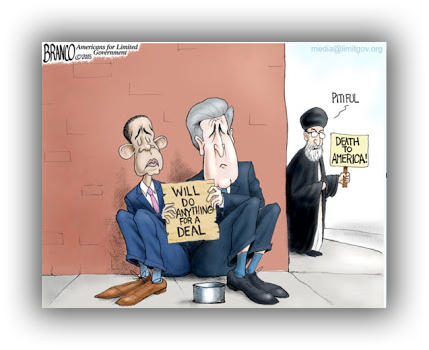
The detente with America did not even cause Iran to abandon its calls of death to America, Taheri notes.
He concludes "Kennedy, Nixon and Reagan responded positively to positive changes on the part of the adversary," whereas "Obama is responding positively to his own illusions." Read the full post here.
Tuesday, June 16, 2015
'Grinding America Down' - Military Reform Plans Would Make US Army 'Paper Tiger' - Tactics Analyst.

'Grinding America Down' - Military Reform Plans Would Make US Army 'Paper Tiger' - Tactics Analyst. (RT).
WASHINGTON (Sputnik) — Plans to make the US Army more agile and mobile at the expense of heavy weapons are paving the way for future military disasters, retired US Army Colonel Douglas Macgregor told Sputnik.
“Today’s Army is courting humiliating defeat if and when it takes on Russian, Chinese or even second-tier nation-state forces equipped with modern military technology from Russia or China,” Macgregor said on Monday.
Macgregor is one of the leading US Army experts on combat tactics. He was the director of the Battle of 73 Easting during the 1991 Gulf War against Iraq, the largest US armor combat victory since World War II.
“Captured by visions of light troops mounted on wheels or falling out of airplanes, [the Pentagon] is building a force for uncontested, permissive environments against weak peoples without armies, air forces, air defenses or navies,” Macgregor said.
“That’s a dead end in a confrontation with the Russian Army,” he added.
The US military’s weakness is obvious to foreign governments, including to Russia, Macgregor explained.
“[Russian President Vladimir] Putin is doing what he can to expose the US ‘paper tiger’,” he said. Macgregor also noted Russia’s leader remained focused on his country’s interests, and predicted the Kremlin would succeed in extending its influence in Eastern Europe.
“As for Putin, he’s on a roll and I suspect he will roll up the rest of Ukraine east of the Dnieper one way or the other,” Macgregor said.
The vaunted US and NATO Rapid Response Force, he argued, would pose negligible threat to Russian forces in any conflict situation.
Macgregor concluded the Russian army was developing the experience and expertise for classic concentration of force tactics involving coordinated use of artillery, main battle tanks and air support.
Macgregor also said that senior US military commanders are reluctant to send heavy weapons to Ukraine and Poland despite increasing political calls to do so.
“The National Command Authority has resisted calls from the governments of the aforementioned nations to station US forces on their territory,” Macgregor said on Monday. “The Poles have pressed us for US ground and air forces for years.”
The US Department of Defense is considering a proposal to place M1 Abrams tanks, Bradley Fighting Vehicles as well as armored howitzers in NATO member countries in the Baltic region and Eastern Europe in a bid to stem what is viewed as Russian aggression.
However, Macgregor, a leading US expert on modern combat infantry tactics, said that the plan was opposed by senior US Army generals, who believe it over-extends their forces.
On the other hand, Washington hawks criticize the proposal, claiming the forces which would be sent are too small and weak to pose any credible deterrent.
“This is not an American initiative. The initiative is from the NATO members,” Macgregor said. “Meanwhile, the US Army is being cut to 420,000 from its strength of 475,000.”
When asked if the Russian government and top military commanders would view the deployment of US heavy ground forces in Ukraine or Poland as an additional threat, Macgregor replied, “Absolutely.” Hmmm........If the Russian Army would actually start a 'Blitzkrieg' in Winter there would be nothing to stop them to reach the British Channel....unless you use Nuclear weapons.
Colonel Macgregor is a decorated US Army combat veteran and an author of five books. His next book “Margin of Victory” is set to be published in 2016.

Wednesday, May 13, 2015
Obama: We are prepared to use all elements of our power to secure our interests in the Middle East.

Obama: We are prepared to use all elements of our power to secure our interests in the Middle East.(AA).
Washington, DC, Asharq Al-Awsat—When he receives leaders and officials from the Gulf Cooperation Council (GCC) at the White House on Wednesday and at Camp David on Thursday, US President Barack Obama will be keen to solidify his country’s historic alliance with the Gulf while pressing for a nuclear deal with Iran. Having issued the invitation for the summit in the immediate aftermath of the framework agreement with Iran last April, Obama must now deal with concerns from the Arab world that Tehran’s leaders will take advantage of any nuclear deal to further extend Iran’s reach in the region.
In an exclusive interview with Asharq Al-Awsat, his first with an Arabic-language newspaper, President Obama concurred that “the countries in the region are right to be deeply concerned about Iran’s activities, especially its support for violent proxies inside the borders of other nations.”
He also outlined his main priorities for the summit—and the region. He explains his reasoning for extending an invitation to the leaders of the GCC, saying it is part of an effort to “further strengthen our close partnerships, including our security cooperation, and to discuss how we can meet common challenges together. That includes working to resolve the conflicts across the Middle East that have taken so many innocent lives and caused so much suffering for the people of the region.”
Obama is expected to reassure Gulf allies of his country’s commitment to their security. He told Asharq Al-Awsat that “there should be no doubt about the commitment of the United States to the security of the region and to our GCC partners.”
Asharq Al-Awsat: You will be meeting leaders and officials from the GCC in Washington tonight and tomorrow at Camp David. Beyond words of support that you have given them in previous meetings, what actions and guarantees will the United States be committing to—and will they include guarantees for the Hormuz and Bab El-Mandeb straits?
Barack Obama: I have invited senior officials of the GCC states to Washington to further strengthen our close partnerships, including our security cooperation, and to discuss how we can meet common challenges together. That includes working to resolve the conflicts across the Middle East that have taken so many innocent lives and caused so much suffering for the people of the region. I’m grateful that all the GCC countries will be represented, and I look forward to our discussions at both the White House and Camp David.
Our meeting is rooted in our shared interest in a Gulf region that is peaceful, prosperous, and secure. As I said at the United Nations two years ago, the United States has core interests in the Middle East, including confronting external aggression; ensuring the free flow of energy and commerce, and freedom of navigation of international waters—and this includes the Strait of Hormuz and Bab El-Mandeb; dismantling terrorist networks that threaten our people; and preventing the development or use of weapons of mass destruction. I’ve made it clear that the United States is prepared to use all elements of our power to secure these interests.
These are not just words; they are backed by a strong record of real action. Across six decades, the United States has worked with GCC countries to advance our mutual interests. Americans have served in the region, and given their lives, for our mutual security. Thousands of US personnel serve in the Gulf region today to reinforce regional stability. Our armed forces train together in numerous major military exercises every year. So there should be no doubt about the commitment of the United States to the security of the region and to our GCC partners.
My hope is that this week’s meeting will deepen our cooperation across a range of areas. Together, we have the opportunity to improve our security coordination and help our GCC partners strengthen and further integrate their defense capabilities in a range of areas including missile defense, maritime security, cyber security, and border security. We can intensify our counterterrorism efforts with a focus on stemming the flow of foreign fighters and terrorist financing to conflict zones, as well as countering the evil ideology of ISIL [the Islamic State of Iraq and Syria, ISIS]. We can work together to resolve ongoing conflicts—in Iraq, Syria, Yemen, and Libya—and address underlying sectarian tensions which hold the region back.
I will have the opportunity to update the senior GCC officials on our negotiations toward a comprehensive deal to prevent Iran from obtaining a nuclear weapon, which I strongly believe is the best way to ensure the security of the region, including our GCC partners. At the same time, this week’s meetings will be an opportunity to ensure that our countries are working closely to counter Iran’s destabilizing behavior across the Middle East, including Iran’s support for terrorist groups.
Q: There are many concerns about the role of Iran in countries like Syria and Yemen, stemming from the Iranian regime’s belief in “exporting the revolution.” How do you see Iran’s role in the region today, and how convinced are you that Iran’s rulers can be “constructive actors” if the nuclear deal is reached?
Iran clearly engages in dangerous and destabilizing behavior in different countries across the region. Iran is a state sponsor of terrorism. It helps prop up the Assad regime in Syria. It supports Hezbollah in Lebanon and Hamas in the Gaza Strip. It aids the Houthi rebels in Yemen. So countries in the region are right to be deeply concerned about Iran’s activities, especially its support for violent proxies inside the borders of other nations.
It’s important to remember that Iran already engages in these activities without a nuclear arsenal. We can only imagine how Iran might become even more provocative if it were armed with a nuclear weapon. Moreover, it would become even harder for the international community to counter and deter Iran’s destabilizing behavior. That’s one of the reasons why the comprehensive deal we’re pursuing with Iran is so important—by preventing a nuclear-armed Iran it would remove one of the greatest threats to regional security.
Even as we’ve pursued a nuclear deal with Iran, the United States has remained vigilant against Iran’s other reckless behavior. We’ve maintained our robust military presence in the region and continued to help the GCC states build their capacity to deter and defend against all forms of external aggression. We’ve continued to fully enforce sanctions against Iran for its support of terrorism and its ballistic missile program—and we will enforce these sanctions going forward, even if we reach a nuclear deal with Iran.
When it comes to Iran’s future, I cannot predict Iran’s internal dynamics. Within Iran, there are leaders and groups that for decades have defined themselves in opposition to both the United States and our regional partners. I’m not counting on any nuclear deal to change that. That said, it’s also possible that if we can successfully address the nuclear question and Iran begins to receive relief from some nuclear sanctions, it could lead to more investments in the Iranian economy and more opportunity for the Iranian people, which could strengthen the hands of more moderate leaders in Iran. More Iranians could see that constructive engagement—not confrontation—with the international community is the better path. There are two paths available to Iran. One is continued confrontation; the better one is a more constructive approach to the region that would allow Iran to become more integrated with the global community. But even if the political dynamics in Iran do not change, a nuclear deal becomes even more necessary because it prevents a regime that is hostile to us from obtaining a nuclear weapon. Hmmm......The 'make believe presidency in it's make believe reality'. Read the full story here.
Thursday, February 12, 2015
"CHANGE" - Vital Anti-Terrorism Program at “High Risk” for Years.

"CHANGE" - Vital Anti-Terrorism Program at “High Risk” for Years. HT: JudicialWatch.
For two and a half decades critical federal programs with serious flaws have been singled out as “high risk” in a biennial audit that’s largely discounted by Congress even though many are longtime offenders, including a crucial anti-terrorism initiative designed to protect the homeland.
The 2015 report was released today and it’s an exhausting 404 pages long, but Judicial Watch has plucked out some examples of those celebrating their silver anniversary on the “high risk” roster.
Here are a few of the scarier ones that have also been deemed high risk for years; since 2005 the U.S. government has failed to establish effective mechanisms for sharing and managing terrorism-related information to protect the homeland, according to the report.
Since 2003 the Department of Homeland Security (DHS) has not been able to strengthen security management functions and since 2007 Uncle Sam has not adequately ensured the effective protection of technologies critical to U.S. National Security interests.Read the full story here.
Friday, January 23, 2015
'Vorsprung durch technik' - China Launches Three Warships In One Day, Setting A New Record.
 |
| On this fine January 22, 2015 day, you can see three recently launched Chinese warships: the massive Type 071 LPD in front, the Type 815G spy ship somewhat hidden behind it, and the new Type 054A frigate in the background (which orange coverings on its sensor and communications domes above the helicopter hangar). |
China Launches Three Warships In One Day, Setting A New Record. (Popsci).
For comparison, the U.S. Navy commissioned only four warships in all of 2015.Not since World War II has a single shipyard launched multiple large warships in a single day. But Hudong-Zhonghua Shipyard in Shanghai, one of China's best naval and civilian shipyards, just did that. On January 22, 2015, it showed off its prowess in military mass production by simultaneously launching a Type 071 Landing Platform Dock (LPD) amphibious warship, a Type 054A frigate, and a Type 815G Electronic Intelligence (ELINT) ship. For comparison, the U.S. Navy commissioned only four warships (including a submarine) in all of 2014.
The three warships of January 22, 2015 will be joined in the following years by other PLAN milestones, such as the Type 055 destroyer, domestically built aircraft carriers and the quiet Type 095 nuclear attack submarine. Modern naval construction techniques like modular building and computer aided design have improved the pace, cost effectiveness and capability of Chinese warships.
Amidst sequestration and austerity triggered cutbacks, western navies are struggling to keep naval shipyards in business, China's success in rapidly launching modern warships is even more stark. Hmmm...... How Empires fade away.Read and see the full story here.
Wednesday, September 10, 2014
US House Condemns Obama for Law-Breaking Swap of American Prisoner for Guantanamo Inmates

US House Condemns Obama for Law-Breaking Swap of American Prisoner for Guantanamo Inmates. (RN).
US House of Representatives voted to condemn President Barack Obama for non-execution of the requirement to give 30-day notice to Congress about the exchange of American prisoner Bowe Bergdahl for five Taliban commanders, imprisoned in Guantanamo, The Guardian reported.
“It shall be in order to consider in the House a resolution, House Resolution 644, condemning and disapproving the Obama administration’s failure to comply with the lawful statutory requirement to notify Congress”, - Representative Reid Ribble said on Tuesday at the House Debate on Bergdahl.
Under US law, Congress must be notified of any transfer of Guantanamo Bay prisoners at least 30 days in advance. The US administration explained the failure to give notice with concerns about the sergeant’s health and concerns that the details of the swap would be divulged.
The news of the exchange raised security concerns in the US House as House Speaker John Boehner said, after a Republican Conference meeting in June, that freeing the Taliban commanders from US custody made Americans less safe.
In May, US President Barack Obama sanctioned the release of five Taliban commanders from the Guantanamo prison in exchange for US Army sergeant Bowe Bergdahl, who was captured by Islamist fundamentalists in Afghanistan in 2009. In July 2014 US Army officials informed that Bergdahl would continue his duty in the United States.
Poll: Most Say Obama’s Presidency a Failure.

Poll: Most Say Obama’s Presidency a Failure. Politico.
A majority of voters believe Barack Obama’s presidency has been a failure, a new poll says.
According to a Washington Post/ABC News poll released Tuesday, 52 percent of Americans say Obama’s presidency has been a failure, compared with 42 percent who believe it has been a success. Thirty-nine percent believe strongly that his presidency is a failure, just 3 points below his total success score.
The numbers are similar to the president’s approval rating, as reported in the survey. Fifty-one percent of Americans disapprove of Obama’s job performance, while 42 percent approve. More people disapprove than approve of Obama’s handling of the economy, implementation of the Affordable Care Act, international affairs and immigration issues.
A majority of registered voters - 54 percent - say their feelings for Obama will not be a factor in their vote in the upcoming November midterm elections. Twenty-seven percent say their vote will express opposition to the president, while 19 percent say it will express support.Read the full story at POLITICO
Subscribe to:
Posts (Atom)
