Showing posts with label sanctions that benefit. Show all posts

Tuesday, May 2, 2017

U.S. Judge Wants To Know If Iran or Turkey Paying Lawyers In Reza Zarrab Iran Sanctions Case.


U.S. Judge Wants To Know If Iran or Turkey Paying Lawyers In Reza Zarrab Iran Sanctions Case.(rferl).

A U.S. judge said he wants to know whether Iran employs any lawyers for a wealthy Turkish-Iranian gold trader accused of helping Tehran evade U.S. sanctions.

In an order on Mary 1, Manhattan District Judge Richard Berman said he planned to ask at a hearing on May 2 whether former New York Mayor and Trump adviser Rudolph Giuliani or any other lawyer for trader Reza Zarrab had been hired by Iran or Turkey.

The hearing will focus on whether conflicts of interest bar Giuliani and former U.S. Attorney General Michael Mukasey from representing Zarrab. The trader has pleaded not guilty to U.S. charges that he directed a conspiracy to launder money through U.S. banks on behalf of Iran's government in violation of U.S. sanctions.

Giuliani and Mukasey say they were hired to try to negotiate a political resolution of his case between the United States and Turkey.

The attorneys have discussed Zarrab's case with U.S. authorities and Turkish President Recep Tayyip Erdogan, who has accused U.S. authorities of having "ulterior motives" in bringing the charges.

In an affidavit last month, Giuliani said authorities in both countries were "receptive" to a diplomatic deal.


Way more information on the Iranian Lifeline By Obama's BFF Erdogan can be read on WashingtonPoint his account, recomended reading if you want the truth.

Friday, November 11, 2016

US Dep of Justice accuses Iranian, Turkish citizens of evading sanctions.


US Dep of Justice accuses Iranian, Turkish citizens of evading sanctions. (Taz).

The Manhattan Attorney has announced charges against Turkish and Iranian nationals for conspiring to evade US sanctions against Iran as well as other offences.

They allegedly used the US banking system to conduct international financial transactions for Iranian entities,” Department of Justice’s official website reported.

Habibollah Zarei, Bora Deniz, Nesteren Zarei Deniz and Abdullah Evren Erdem are accused of conducting hundreds of millions of dollars worth of transactions on behalf of the government of Iran and other Iranian entities using the US financial system, which was barred by United States sanctions.

They are also accused of laundering funds in connection with those illegal transactions and defrauding several financial institutions by concealing the true nature of these transactions.

“The four defendants are alleged to have orchestrated fraudulent transactions that were intended to hide the fact that the transactions were for the benefit of Iranian entities and to have laundered funds in connection with that illegal activity,” said the Department of Justice.

All four defendants currently remain at large.

The charges on Turkish and Iranian citizens come as the Manhattan Attorney also announced Nov. 7 that the files of four other Iranian and Turkish citizens – charged of evading the sanctions – were submitted to a court.

According to a report, superseding indictment alleges that four defendants – Mohammad Zarrab, Reza Zarrab, Camelia Jamshidy and Hossein Najafzadeh – allegedly used the US banking system to conduct international financial transactions for an Iranian airline put under sanctions for supporting terrorist groups.

The superseding indictment further alleges that they participated in financial transactions for the benefit of Mahan Air, an Iranian airline sanctioned for providing services for the Iranian Qods Force and Hizbullah

Reza Zarrab was arrested on March 19, 2016, and is scheduled to stand trial on January 23, 2017.

Mohammad Zarrab, Jamshidy and Najafzadeh remain at large.

Monday, May 9, 2016

US returned 73 Persian artifacts to Iran after years of follow-ups by Iran's cultural heritage officials.


US returned 73 Persian artifacts to Iran after years of follow-ups by Iran's cultural heritage officials. (AA).

Foreign Ministry Spokesman Hossein Jaberi Ansari said on Sunday that 73 ancient artifacts belonged to Iran have been safely returened from the United States to their homeland.

Iranian Foreign Ministry Spokesman Hossein Jaberi Ansari made the announcement on Sunday.

"After consultations, 73 valuable ancient artifacts belonging to the Sassanid period were returned to the Islamic Republic of Iran by the US government," he said.

"The valuable ancient cargo was delivered to the National Museum of Iran on Sunday afternoon in a ceremony attended by the foreign ministry representative," Jaberi Ansari added.

In recent years, Iran has been successful in returning home its stolen belongings, including artifacts and ancient objects.

Back in April 2015, Iran received 108 ancient artifacts known as the Chogha Mish Collections from the US University of Chicago, marking the second successful return of Iranian artifacts in less than a year.

Also in 2013, Washington returned a Persian artifact to Iran after 10 years of consultations.

The 2,700-year-old Persian silver drinking cup cast in the form of a griffin was returned to Iranian President Hassan Rouhani as a token of good will while he visited the US to participate in the 68th Annual Session of the UN General Assembly in New York.

The ancient griffin had been in the US since 2003 when an art dealer smuggled it into the US.
Najafi, who is also the head of the cultural heritage and tourism organization, said the US State Department returned the artifact as a sign of good faith in a bid to improve cultural relations between Tehran and Washington.
Najafi said American authorities told him the ancient artifact was seized at a US airport from an Arab antique dealer in 2003.

The US officials believe the relic dates back to 700 years before Christ when the Achaemenid Empire ruled Persia.Hmmm......Don't tell me they decided this as well on the way to the airport?
This was decided even before Rouhani spoke at the UN !!!

Monday, April 25, 2016

Ahmadinejad’s Gov’t Is to Blame for US Seizure of Iranian Assets: Governor of the Central Bank of Iran.


Ahmadinejad’s Gov’t Is to Blame for US Seizure of Iranian Assets: Governor of the Central Bank of Iran. (Iranfrontpage).

The Governor of the Central Bank of Iran (CBI), Valiollah Seif, held the former Iranian administration responsible for a recent US court ruling to seize near $2bn of Iran’s frozen assets, saying Mahmoud Ahmadinejad’s government was too negligent in making investments in the US.

Unfortunately, in the previous government, there was negligence in buying bonds and making investments in the US dollar,” Seif said.

Seif noted that “u-turn” transactions with the Islamic Republic were exceptionally permitted in the US dollar sanctions against Iran, but Ahmadinejad’s administration was not careful and cautious enough in making the investments.

The former government’s officials should have considered the issue and exercised enough caution, but in spite of warnings by CBI experts against investments on dollar-based bonds, they (the then officials) made the purchases and set the stage for the Iranian nation’s loss, he added.

The warnings by those experts came true, and unfortunately, the ban on dollar-based transactions with Iran was once again imposed in 2008, and American banks were banned from having such transactions with Iran,” Seif said.

If the bonds had not been purchased at that time, there would have been no money to be seized by the Americans, he added, as reported by the CBI’s website.

The measures taken by the forerm government led to other hostile moves by the US, including the 13599 Executive Order against the CBI, he noted.

He was referring to an executive order issued in 2012, based on which the US Treasury blocked “all property and interests in property of the Government of Iran, including the Central Bank of Iran, and of all Iranian financial institutions, regardless of whether such persons are located or incorporated inside or outside of Iran”.

Therefore, he concluded, all these unfair and illegal measures by the Americans took place under Ahmadinejad’s tenure, which was a time when the Iranian government considered sanctions to be barely effective, even futile.

If any of these moves had been prevented at that time, the recent US court ruling could not have happened, he noted.

Rouhani’s Gov’t Evading Responsibility by Pinning Blame on Predecessors: Analyst.

Meanwhile, Kezem Anbarlouie, a political analyst, believes that the incumbent government of President Hassan Rouhani is trying to blame Ahmadinejad’s to whitewash its own deficiencies.
in a comment published by Tasnim and translated by IFP, Anbarlouie referred to similar remarks by First Vice-President Eshaq Jahangiri on the responsibility of the former government for the asset seizure, describing his remarks as “shocking”.

“The First VP said the previous government was not prudent enough, and spent part of the CBI’s resources on purchasing bonds, even if it knew the Americans were not committed to international regulations,” Anbarlouie said.

He further argued that if Americans are not committed to international regulations, Rouhani’s government should also have refused to sign the recent nuclear deal (JCPOA) with them.

The previous government was in conflict with the US, and everyone in the world knew that; however, the US government did not dare to seize Iran’s money at that time,” he went on to say.

The 11th government has made an agreement with the Americans and shaken hands with them while they promised to release Iran’s frozen assets, but now, they have not only refused to release them, but they are also stealing and seizing the country’s money once again,” the analyst added.

To those who say the former government is to blame for the US seizure of Iranian assets, one should say, ‘What were YOU doing? Do not blame the former government for your own imprudence’.”

Quoting materials from Iran Front Page is permitted only if the source is mentioned by name.

Monday, April 11, 2016

New Banking channels will allow Iran to access $6bn of India’s oil debts to Iran.


New Banking channels will allow Iran to access $6bn of India’s oil debts to Iran. (Iranfrontpagenews).

Iranian Minister of Petroleum Bijan Zangeneh said Iran and India are discussing setting up banking channels which will allow the Central Bank of Iran to access $6bn of India’s oil debts to Iran.

Speaking on the sidelines of the Iran-India business conference at Tehran Chamber of Commerce on Saturday evening, Zangeneh told reporters that Tehran and New Delhi are in talks to add two more banking channels to the current one so that access can be granted to $6bn of Iran’s oil money in Indian banks.

The Indian side has announced it would immediately repay its debts to Iran once the channel is open,” the official said.

He also said that India has stopped repaying its oil debts to Iran in goods supply.

Asked how the debts will be paid to the CBI, he said they will be paid in euros, not in goods.

Regarding the construction of a gas pipeline from Iran to India, Zangeneh said no understanding has been made in this regard between the two Asian countries, and the Indian side must study the case and present its assessments to Iran.

Iran can export oil to India whether through pipelines or in the form of liquefied natural gas (LNG) cargos.

Petrochemical Sector

He said Indian developers have indicated their keenness to finance petrochemical projects in Iran, and that the latter has agreed to supply their plants with petrochemical feedstock in return.

Quoting materials from Iran Front Page is permitted only if the source is mentioned by name.

Monday, April 4, 2016

Iranian court delivers death sentence to Billionaire Babak Zanjani


Iranian court delivers death sentence to Billionaire Babak Zanjani. (TAZ)

An Iranian court has delivered a death sentence formerly issued for billionaire Babak Zanjani.

Zanjani’s lawyer Rasoul Koohpaye Zadeh said he received the sentence from Revolution Court Branch 15, ILNA news agency reported April 4.

“The delivery process has in fact begun today as the verdict comes in 318 pages and we should start taking notes, which takes time. When we are done taking notes, the verdict is considered as delivered, since which day we will have 20 days to plea,” the lawyer added.

A ruling announced March 6 convicted Zanjani and sentenced him to death, according to the Islamic juristic laws.

In December 2013, Iranian judiciary officials accused Zanjani of massive fraud at the Oil Ministry and money laundering. He has been kept in custody and attended court hearing sessions since then.

After sanctions were imposed against the National Iranian Oil Company, Iran had to partially export its oil through Zanjani's channels. Meanwhile, the ministry said Zanjani still owes more than two billion euros for the oil exports he handled on behalf of the former government.

An Iranian-Turkish wealthy businessman, Reza Zarab who is in the center of a major financial scandal in Turkey, revealed that his leader, billionaire Babak Zanjani, led a money laundering operation in Turkey.


Zanjani was involved in the sales of gold by Turkey to Iran, a case that has sparked an extensive investigation for corruption in Turkey.

The state-run IRNA news agency reported on January 3 that according to the information broadcast on the Turkish public television: "Reza Zarab has confirmed that Babak Zanjani was its director."

Babak Zanjani was arrested last week in Iran, as a consequence of a financial scandal in connection with the illegal activities of the mullahs in Turkey that has shaken that country.

According to a Turkish television, Zanjani and Zarab worked for transferring at least a planeload of gold bars from Istanbul airport to Dubai.

Persian language Ayandeh website reported on January 2 that "the latest information on the record indicates that the Iranian banking mafia has received a bribe of €4 billion for laundering operation" for a sum of $ 87 billion.

Related: US prosecutors charge Turkish 'Gold Trader' Zarrab at Heart of Turkey Graft Scandal.


Wednesday, March 23, 2016

US prosecutors charge Turkish 'Gold Trader' Zarrab at Heart of Turkey Graft Scandal.

U.S. Attorney Announces Arrest Of Turkish National For Conspiring To Evade U.S. Sanctions Against Iran, Money Laundering, And Bank Fraud . (Bloomberg)


Reza Zarrab, a gold trader at the center of a bribery scandal that engulfed Turkey’s leadership more than two years ago, was charged by the U.S. of running a scheme to help the Iranian government launder hundreds of millions of dollars and evade economic sanctions.

Zarrab, 33, owner and operator of Royal Holding A.S., and two others, are accused of using a web of companies over five years to induce U.S. banks to unwittingly process transactions that violated international sanctions against Iran, according to an indictment unsealed on Monday.

The charges are a blow to Turkish President Recep Tayyip Erdogan, who has repeatedly insisted that allegations of corruption against him and his inner circle were nothing more than a coup attempt.

In response to the scandal centered around Zarrab in 2013, Erdogan turned Turkey’s bureaucracy upside-down, dismissing thousands of state employees, police officers and prosecutors, with many jailed. He also labeled a group of former allies he blamed for the accusations, the Gulen religious movement, a terrorist organization.

Zarrab had denied any wrongdoing amid the Turkish investigation, saying the business was legitimate. The ministers also denied the charges. All charges against him and members of Erdogan’s government were eventually dropped.

The U.S. indictment suggests “that the allegations of sanctions-busting were strong enough to merit U.S. action, regardless of the political consequences," said Aaron Stein, senior fellow at the Atlantic Council’s Hariri Center for the Middle East and author of the book "Turkey’s New Foreign Policy."

This "is a big deal because of Zarrab’s obvious connections to the AKP," he said, referring to the party Erdogan founded, which has governed Turkey since 2002.

Not mentioned in the U.S. indictment is Turkiye Halk Bankasi AS, the Turkish state-run bank that processed Zarrab’s payments and whose former chief executive officer, Suleyman Aslan, was also embroiled in the scandal and briefly jailed. Police found millions of dollars stuffed into shoe boxes when they raided Aslan’s home in Dec. 2013. He said the money was donations he was collecting for Islamic schools in Turkey and Macedonia.

In a television interview on Turkey’s ultra pro-government A Haber news in April 2014, Zarrab estimated he had facilitated the transfer of about $12 billion in gold, or about 200 tons, to Iran. The surge in exports driven by that business was so rapid and so extensive -- gold transfers to Iran jumped from $53 million in 2011 to $6.5 billion in 2012 -- that it distorted Turkish trade figures. Read the full story here. Hmmm......Don't worry Obama will protect his 'brother' Erdogan.The indictment can be read here.


Saturday, March 12, 2016

Belgium, Turkey to be involved in Iran’s Gas, Energy Market.


Belgium, Turkey Eye Presence in Iran’s Gas, Energy Market. (IranFrontpage).

The Belgian deputy prime minister said Brussels and Ankara will cooperate on major gas and energy projects in Iran under a joint venture agreement.

Didier Reynders said Friday that Belgium and Turkey have agreed to cooperate for construction of natural gas power plants and renewable energy projects in Iran in the wake of the removal of anti-Tehran sanctions.

“With the lifting of the embargos on Iran, there will be many changes in the energy sector and we will see new investments in the country,” Reynders said as quoted by Anadolu Agency.

Turkish and Belgian companies are already cooperating in a number of projects,” he added.

There has been growing international interest in trade ties with Iran since Tehran and the Group 5+1 (Russia, China, the US, Britain, France and Germany) on July 14, 2015 finalized a comprehensive deal on Iran’s nuclear program and implemented it on January 16.

The comprehensive nuclear deal, also known as the Joint Comprehensive Plan of Action (JCPOA), terminated all nuclear-related sanctions on Iran after coming into force. Hmmm.......Belgium has been planning this a long time, No wonder the Belgian king gave Erdogan a knighthood at his latest visit to Brussels.

Quoting materials from Iran Front Page is permitted only if the source is mentioned by name.

Related:  2015:  'Sanctions that Benefit' - Iranian MPs Visit Belgian Gas Transmission Firm.

               2014 - February 22 :  Belgium foreign affairs minister (in search of cheap natural gas) to meet Iranian counterpart in Tehran.


Monday, February 29, 2016

Israel Requests US Bunker-Busting Bombs with Increased Power.


Israel Requests US Bunker-Busting Bombs with Increased Power. (IMRA).

On Monday, Joe Biden will land at Ben Gurion Airport, for his last visit as Vice President of the United States. Ostensibly, this is one of the more boring visits: current Democratic administration is in his last year, and Biden himself had decided not to run for the Democratic presidential nomination, as many vice presidents have done before him.

Still, the visit arouses huge interest, especially in the Israeli defense establishment. The reason: the discussions with the United States regarding a new framework agreement for defense aid entered the final straight, and Biden might bring about some news on the matter, or at least a hint.

Anyway, shortly after Biden's visit, the defense minister will visit Washington, after which Prime Minister Benjamin Netanyahu will also visit the United States. Therefore, the aid agreement is expected to be signed by the end of March, at the latest. Israel is counting on the American administration to be generous towards Israel's defense needs at this time, in order to win the support of the Jewish vote (and mostly the Jewish donors) prior to the presidential elections.

Aid or "Compensation"?

To understand how the coming month will be crucial in terms of the Israeli defense ministry, we need to understand the context: the US elections will be held in November 2016, whereas the previous defense aid agreement between Israel and the United States will expire in 2017. The 10-years-long agreement set the extent of the defense aid back in 2007. According to the soon to be expired agreement, Israel received each year $ 3.1 billion. This is a huge sum, which constitutes more than 20 percent of Israel's defense budget. Under the terms of the aid, the Ministry of Defense has received permission to convert half a billion dollars each year into NIS, to use the money for local acquisitions. The remainder is used as the primary budget source, to finance IDF equipment of central combat platforms such as fighter jets and helicopters.

Beyond the generous annual aid, Israel receives additional aid from the United States for special projects. For example, the US has funded the equipping of seven of the nine Iron Dome batteries. In addition, the US DoD had collaborated with the Israeli defense establishments in the development and funding of other major missile defense projects - "Arrow 3" and "David's Sling".

It was recently reported that the Americans will also deliver funds for projects that will assist the fight against underground tunnels built by Hamas in the Gaza Strip. Furthermore, the IDF and the US military has an agreement in which Israel could use American military equipment, kept in storages in Israel, in emergencies. To top that, the US Army also operates an innovative and classified radar system in the Har-keren mountaintop in the Negev region. Israelis are not allowed to see it firsthand (the closed US area on Israeli soil generates considerable resentment in the defense establishments).

Harming the Israeli national honor or not, the new aid agreement on the agenda is also considered as compensation for the nuclear deal with Iran in summer 2015. The truth is that the compensation is not for the nuclear deal, but for the massive arms sales of American companies in the Persian Gulf.

Not many are aware, but the entire region is in an intense arms race, as Iran plans to spend no less than $ 20 billion of its funds, which were frozen during the economic sanctions, in order to finance the procurement of advanced weapons systems, primarily from Russia. Iran's neighboring countries fear its massive procurement and its transformation to a nuclear power, sooner or later (no leader in the Persian Gulf believes that the agreement will prevent Iran from attaining a nuclear bomb). For this reason, they also acquire weapons, mainly from France and the United States (including many squadrons of modern fighter aircraft, made by the two countries).

This massive equipping is a great celebration for the US defense companies, but these weapons may one day be directed against Israel. Because the United States is committed to maintaining Israel's qualitative edge (under a law passed years ago in Congress) - Israel is expected to receive increased aid, to allegedly ensure this advantage.

Aid Talks

Sources very involved in the defense and diplomatic relations between Israel and the United States, are confident that Israel had already missed an excellent opportunity to boost the "compensation". It was near the time the agreement with Iran was signed. "Before signing the agreement, the American government was willing to give Israel almost everything it had wanted, to "silence" the criticism of the agreement. But because the Prime Minister has decided to fight Obama, the Americans have taught him a lesson and did not promise any compensation," said a source close the subject.

Now, as mentioned, Israel hopes that the Democrats' electoral considerations prevail over the US administration's hostility towards the current Israeli government. But what Israel really wants and what would be the extent of the new aid? Talks over the subject between Israeli and American teams began last fall, as part of negotiations between the Israeli Defense Ministry and the Pentagon. During those conversations, Head of the IDF Planning Directorate, Maj. Gen. Amikam Norkin, presented the IDF's needs to his US colleagues.

During the past few weeks, the aid negotiations was intensified and the reins were passed to PM Netanyahu's hands, who deals with the issue closely. The person who coordinates for the subject is the acting Head of the National Security Council, Ya'akov Nagel, who works regularly with the head of the US National Security Council, Dr. Susan Rice. Originally, Nagel started in the Administration for the Development of Weapons and Technological Infrastructure (MAFAT) in IMOD, and is currently a candidate for Heading MAFAT. Other major candidates mentioned, were Brig. Gen. (Res.) Dr. Danny Gold, who is considered as the father of "Iron Dome"; Maj. Gen. (Res.) Ami Shafran; and Brig. Gen. (Ret.) Eytan Eshel and Brig. Gen. (Res.) Shmuel Yachin. The four of them served as Heads of the IDF's R&D department.

Meanwhile, a new Head of the National Security Council was appointed this week, instead of Yossi Cohen, who has been appointed as Head of Mossad in early January: Brig. Gen. (Ret.) Avriel Bar-Yosef, originally a Navy officer, received the prestigious appointment.

Back to the US aid: the two main questions on the agenda are concerning the sum of the annual aid, in the decade between 2017 and 2027, and the quality of weapons that Israel will receive. Israel expects a significant boost in the annual aid, as part of "compensation" for the nuclear deal. Sums of even 4 and 5 billion dollars were heard. The second question, which depends on the actual sum of the defense aid, is what weapons systems Israel could purchase with that money.

Israel is already planning on at least two squadrons of the future F-35 fighter (the first aircraft of this model will land on Israeli soil this December), but in the Air Force they fantasize about no less than four squadrons by the end of the next decade. In addition, they desire an additional F-15 squadron, a modern array of transport helicopters and refueling aircraft, as well as an aircraft which is half helicopter and half fighter, the V-22.

In addition to aircraft, Israel-US talks involve advanced air-to-ground missiles and much-needed weapons, should it turn out that Iran has been fooling the world and continues to strive for a nuclear bomb. These weapons include, mainly, bunker-busting bombs, more advanced and heavier than the "Lite" version of bunker-busting bombs that the air force received five years ago.

Some of the systems discussed between Israel and the United States are highly classified. In many cases, it is expected that the Americans would agree to include such systems in the weapons arsenal supplied to Israel, only if they know that Israeli defense industries are already developing similar systems in parallel.

Not all interests of Israel and the US are overlapping, but from Israel's perspective, the aid agreement shall determine Israel's military power for many decades. Thus, this month will bring about crucial decisions, and all negotiation tricks will come into play, by both sides.

Wednesday, February 17, 2016

Iran's 'Staunchest ally' the Obama 'admin' lost track of Iranian nuclear shipments to Russia.


Iran's 'Staunchest ally' the Obama 'admin' lost track of Iranian nuclear shipments. HT :IMRA

The United States, which pledged vigorous oversight, has acknowledged that it lost track of Iranian nuclear shipments.

The State Department acknowledged that Washington failed to monitor the transfer of Iranian uranium shipments to Russia. A senior official said tons of Iranian low-enriched uranium arrived in Russia and was taken to an unidentified location.

"It has not yet been decided where exactly Russia will put this information," State Department lead coordinator on Iran, Stephen Mull, said.

In a hearing of the House Foreign Affairs Committee on Feb. 11, Mull was grilled by Rep. Chris Smith regarding Iranian uranium shipments to Russia.

Mull could not tell the House committee the destination of the 25,000 pounds of enriched uranium, but emphasized that Russia could be trusted with the nuclear material.

"We obviously have many differences under many years with Russia, but one of the features of our relationship is pretty close cooperation on protection of nuclear material," Mull said.
But under questioning, Mull acknowledged that Washington did not verify the Iranian shipment, part of Teheran's nuclear agreement with the P5+1 nations
The official said Russia, rather than the International Atomic Energy Agency, was responsible for the Iranian uranium. Instead, IAEA attended the loading of the Iranian uranium on the Russian ship.

"This is a flaw in my opinion," Smith said. "This cannot be allowed to stand." Hmmm............High crimes and misdemeanors

Source: http://www.menewsline.com/article-1173,36354-U-S-Loses-Track-Of-Iranian-Urani.aspx

Tuesday, February 9, 2016

Iran soon to showcase controversial Emad missile.


Iran soon to showcase controversial Emad missile. (Taz).

Iran will showcase its Emad ballistic missile during the Iranian revolution anniversary demonstrations on Feb. 11, said the Propagation Office of Iranian Defense Ministry Feb. 9.

The Emad is the latest generation of Iran’s long-range ground-to-ground ballistic missiles, which can be guided to assure that intended targets are hit, according to the Iranian officials.

In October 2015, Iran test fired the Emad missile triggering controversies.

In particular, several Western sources claimed that Tehran violated the UN Security Council’s resolution 2231 by test-firing the Emad, suggesting it is capable of carrying a nuclear warhead.

The UNSC resolution 2231, adopted July 20, 2015, endorses the nuclear deal between Tehran and the world powers and calls upon Iran not to undertake any activity related to ballistic missiles that can deliver nuclear weapons, as well as launching ballistic missiles, such as Emad.

The Defense Ministry’s Propagation Office today also said that during the revolution anniversary demonstrations, Iran will demonstrate its Simorgh satellite carrier as well.


Simorgh is a two-phase satellite carrier, built by Iran’s defense industry sector as part of the country’s aerospace program. It can deliver the satellites up to 100 kilogram of weight to the 500-kilometer orbit.

The Simorgh features a first stage built from bundling four separate 64,000-pound-thrust engines and a 30,000-pound-thrust engine as a second stage. Although Iran has acknowledged a lift capacity of just 100 kilograms, Nader Uskowi, a Washington-based consultant and blogger on Iran, said optimization of its current design should allow for delivering a 700-kilogram payload into low Earth orbit.

Despite its size, Simorgh as currently designed falls far short of meeting ICBM-class thrust-to-payload requirements, experts say. “This mammoth cannot carry a reasonable re-entry vehicle the 10,000 kilometers needed to reach the United States,” said Uzi Rubin, a former director of Israel’s Missile Defense Organization who consults internationally on missile development programs.

“It’s not the capability that’s significant, but the audacity of the whole thing,” said Rubin. “These guys are thinking big time. They’re diligently following a road map that includes the ability to project strategic power beyond this region.”

Given the rigorous pace and demonstrated achievements of Iran’s missile development program, the Simorgh “could be Iran’s road to an ICBM,” said Tal Inbar, director of Israel’s Fisher Institute Space Research Center.

“For now, it’s untested and extremely inefficient, but in the future, it could be configured to deliver a crude payload to the continental United States,” he said. Hmmm......Anyone seeing similarities to North Korea's 'satellite carrier'? Read the full story here.

Iranian officers visiting North Korea

Monday, February 8, 2016

Satellite images expose Iran's Duplicitous Nuclear Strategy.


Satellite images expose Iran's Duplicitous Nuclear Strategy. HT: Stratfor.

Iran's nuclear deal with the West has come into effect, but that does not mean international concerns about Tehran's nuclear program have been fully resolved. Iran has continued to develop certain military technologies, including ballistic missiles, that could someday be used to support nuclear capabilities. Meanwhile, it has kept its activities at several military installations around the country cloaked in secrecy.

Satellite imagery provided by our partners at AllSource Analysis gives a clear picture of the dual nature of Iran's approach to its nuclear program throughout its negotiations with the West.

The pictures of the Parchin Military Complex, taken in July 2010 and January 2016, respectively, show how Tehran removed potentially incriminating traces of activity at the site while talks were ongoing. It also constructed an underground facility within the complex, where research and weapons development could be concealed. Read the full story here.

Sunday, January 31, 2016

Iran to construct Two new Nuclear power plants in Bushehr soon: Salehi.


Iran to construct Two new Nuclear power plants in Bushehr soon: Salehi. (IranFrontPage).

Head of the Atomic Energy Organization of Iran (AEOI) Ali Akbar Salehi says the Islamic Republic is set to begin the construction of two more nuclear power plants in the southern city of Bushehr soon, Press TV reports.

In the construction of nuclear power plants, as I have already stated, we hopefully, within the next few months, will be witnessing the launching of new reactors. Activities are going on and they are expanding even in some areas,” Salehi said in an exclusive interview with Press TV on Saturday.
He added that Iran and Russia have signed agreements for the construction of “two big reactors in Bushehr.”
In November 2014, Tehran and Moscow struck a deal to build eight more nuclear power plants in Iran.

Russia has already built a power plant in Bushehr. The agreement for Bushehr Nuclear Power Plant was finalized in 1995, but the project was delayed several times due to a number of technical and financial issues.

The 1,000-megawatt plant, which is operating under the full supervision of the International Atomic Energy Agency (IAEA), reached its maximum power generation capacity in August 2012.
In September 2013, Iran officially took over from Russia the first unit of its first 1,000-megawatt nuclear power plant for two years.

Salehi said the recognition of Iran’s enrichment activities by the international community, particularly the UN Security Council, was “one very good achievement” within a nuclear agreement reached between Iran and the P5+1 group of countries, dubbed the Joint Comprehensive Plan of Action (JCPOA).

We are one among the very few or probably the very exceptional countries that its enrichment activity has been recognized by an international body such as the UN Security Council,” the AEOI head said, adding, “One of the achievements within this framework is the fact that we were able to sell or we got this opportunity to sell our enriched uranium and get in return natural uranium or the yellowcake.”

He described JCPOA as a “good deal” that allows Iran to enter the club of countries that can enrich uranium and sell it at global market.


Iran and the five permanent members of the UN Security Council – the United States, France, Britain, China and Russia – plus Germany started to implement JCPOA on January 16.

Quoting materials from Iran Front Page is permitted only if the source is mentioned by name.

Wednesday, January 20, 2016

Saudi Arabia not ruling out their own nuclear bomb in response to Iran.


Saudi Arabia not ruling out their own nuclear bomb in response to Iran. (INN).

Saudi Arabia is not ruling out developing a nuclear bomb if its regional rival Iran obtains one, Saudi Foreign Minister Adel al-Jubeir told the Reuters news agency on Tuesday.

Asked if Saudi Arabia had discussed seeking a nuclear bomb in the event Iran managed to obtain one, al-Jubeir replied the country would do "whatever we need to do in order to protect our people".


"I don't think it would be logical to expect us to discuss any such issue in public and I don't think it would be reasonable to expect me to answer this question one way or another," he told Reuters.  Read the full story here.

Iran's Basij Commander: US Bought Freedom of Spies by Releasing $1.7 bln of Iran's Frozen Assets.


Iran's Basij Commander: US Bought Freedom of Spies by Releasing $1.7 bln of Iran's Frozen Assets. (Fars).

Commander of Iran's Basij (volunteer) Force Brigadier General Mohammad Reza Naqdi said the US agreed to release $1.7 of Iran's frozen funds in a bid to buy freedom of its spies held by Tehran.
The US agreed to repay Iran a $400 million debt and $1.3 billion in interest dating to the Islamic revolution.

"The annulment of sanctions against Iran's Bank Sepah and reclaiming of $1.7mln of Iran's frozen assets after 36 years showed that the US doesn’t understand anything but the language of force," Naqdi said, addressing Basij forces in Tehran on Wednesday.
"This money was returned for the freedom of the US spy and it was not related to the (nuclear) negotiations," he added.
4 Iranian-American nationals who were held for various charges in Iran were freed under a prisoners swap deal on Saturday after the implementation of the nuclear deal clinched between Tehran and the world powers in July. A fifth inmate was also released separately.

"Based on an approval of the Supreme National Security Council (SNSC) and the overall interests of the Islamic Republic, four Iranian prisoners with dual-nationality were freed today within the framework of a prisoner swap deal," the office of Tehran prosecutor said.

The four Iranian-Americans, Jason Rezaian, Amir Hekmat, Saeed Abedini and Nosratollah Khosrawi Roudsari who were jailed in Iran on various charges in recent years, have all been released.

Meantime, a US official said a fifth dual nationality prisoner would also be released by Iran separate from the swap deal. Later reports named this fifth prisoner as Mathew Trevithick.

According to the swap deal, the US also freed 7 Iranian-Americans who were held for sanctions-related charges and asked the Interpol to stop prosecution of 14 other Iranian nationals. 
But according to what Iran's Foreign Ministry Spokesman Hossein Jaberi Ansari said on Monday, the number of the Iranians whose charges have been dropped stands at 21.
The 7 Iranian inmates freed by the US were named as Nader Modanlou, Bahram Mechanic, Khosrow Afqahi, Arash Ghahreman, Touraj Faridi, Nima Golestaneh and Ali Sabounchi.

The 14 Iranians who were mentioned in earlier reports and had charges dropped on Saturday included Saeed Jamili, Jalal Salami, Matin Sadeqi, Alireza Moazzemi Goudarzi, Mohammad Abbas Mohammadi, Kourosh Taherkhani, Sajjad Farhadi, Seyed Ahmad Abtahi, Gholamreza Mahmoudi, Hamid Arabnejad, Ali Moattar, Mohammad Ali She'rbaf, Amin Ravan and Behrouz Dolatzadeh.
Jaberi Ansari did not name the other 7 Iranians whose charges have been dropped.

Republican presidential front-runner Trump pledges to move US embassy from Tel Aviv to Jerusalem.


Republican presidential front-runner Trump pledges to move US embassy from Tel Aviv to Jerusalem. (Jpost).

Republican presidential front-runner seems to make about-face from prior remarks on committing to recognizing Jerusalem as Israel’s undivided capital.

“They want it in Jerusalem,” the front-runner among Republican presidential candidates said in an interview posted Tuesday by The Brody File, a Christian Broadcasting Network show. “Well I am for that 100 percent. We are for that 100 percent.”

David Brody, the CBN journalist, had asked Trump whether he agreed with GOP rivals, including Sens. Ted Cruz, R-Texas, and Marco Rubio, R-Fla., who have pledged to move the embassy from Tel Aviv to Jerusalem once elected.

Trump’s agreement seemed to be an about-face from remarks in December at the Republican Jewish Coalition, when the real estate magnate refused to commit to recognizing Jerusalem as Israel’s undivided capital.

Calling US President Barack Obama “the worst thing that has ever happened to Israel” for negotiating the recent Iran-nuclear deal, Trump pledged loyalty to Israel. Read the full story here.             

Sunday, January 17, 2016

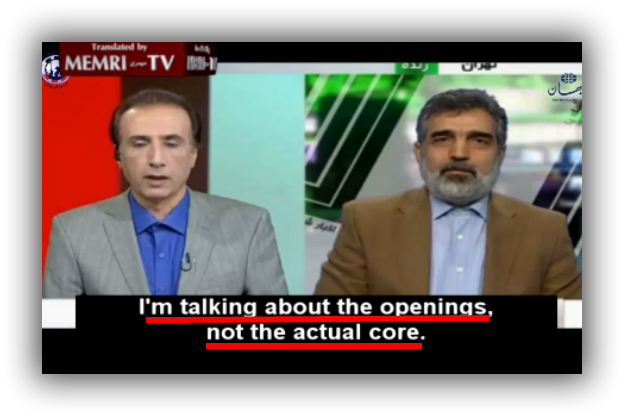
Video - Iran's Atomic Energy Org. Spokesman Explains What Is Being Done in the Core of the Arak Nuclear Reactor


Iran's Atomic Energy Organization Spokesman Kamalvandi Explains What Is Being Done in the Core of the Arak Nuclear Reactor. (MEMRI).

In an interview on Iranian TV on January 14, Behrouz Kamalvandi, the spokesman of the Iranian Atomic Energy Organization, explained that the core of the nuclear reactor at Arak had been removed and would be preserved whole, "as a symbol of our nuclear industry."


US Treasury imposes new ballistic missile sanctions on Iran.


US Treasury imposes new ballistic missile sanctions on Iran. (RT).

The US Treasury says it is imposing new ballistic missile sanctions on Iran after Tehran released five American prisoners. The move also comes less than a day after some of the sanctions imposed on Iran over its nuclear program were removed by the US and EU.

Washington has imposed sanctions on 11 companies and individuals for helping to supply Iran’s ballistic missile program, the Treasury Department stated.

Iran’s ballistic missile program poses a significant threat to regional and global security, and it will continue to be subject to international sanctions,” Adam J. Szubin, acting Under Secretary for Terrorism and Financial Intelligence, said in a press release.
“We have consistently made clear that the United States will vigorously press sanctions against Iranian activities outside of the Joint Comprehensive Plan of Action – including those related to Iran’s support for terrorism, regional destabilization, human rights abuses, and ballistic missile program.”
The Treasury’s Office of Foreign Assets Control says it will also block the assets of Mabrooka Trading, a company based in the United Arab Emirates, for providing Iran with parts used in their ballistic missiles. Others sanctioned include companies and individuals involved in the program, which supervised the testing of two ballistic missiles in 2015.

President Barack Obama’s administration delayed implementing the sanctions for more than two weeks, while negotiations to release two US prisoners being held in Iran were taking place, Reuters reported, citing its sources.

Obama is also expected to make a statement later on Sunday, regarding the Iran deal and the release of five prisoners. Hmmmm......First you let them build and test the missile ...than you sanction them, closing the barn after the cow escaped. 

Iran got Pres Obama to cancel sanctions over illegal missile test by threatening to scuttle prisoner swap.


Iran got Pres Obama to cancel sanctions over illegal missile test by threatening to scuttle prisoner swap. (Reuters).

The day before the Obama administration was due to slap new sanctions on Iran late last month, Iranian Foreign Minister Javad Zarif warned U.S. Secretary of State John Kerry the move could derail a prisoner deal the two sides had been negotiating in secret for months.

Kerry and other top aides to President Barack Obama, who was vacationing in Hawaii, convened a series of conference calls and concluded they could not risk losing the chance to free Americans held by Tehran.

At the last minute, the Obama administration officials decided to delay a package of limited and targeted sanctions intended to penalize Iran for recent test-firings of a ballistic missile capable of delivering a nuclear warhead.

This account of previously unreported internal deliberations was provided by two people with knowledge of the matter.

A third official said Obama had approved the decision to delay the sanctions.

A U.S. official said on Saturday there was no connection between the nuclear deal and the release of the Americans.

The prisoner swap could also come under scrutiny from critics who have questioned the Obama administration’s resolve in dealing with Iran and ability to follow through on its pledge to keep a hard line on sanctions outside those imposed on its nuclear program.

Details of the prisoner talks were a closely held secret, so even within the Obama administration few people realized how perilously close the swap came to falling through.

On Dec. 29, Kerry told Zarif the United States intended to impose new sanctions on Iran over the missile test firings, which were deemed to have violated a United Nations ban, according to a U.S. official and congressional sources.

Zarif countered that if Washington went ahead, the prisoner swap was off, the sources said.

Kerry spoke by phone that night with Treasury Secretary Jack Lew and a White House official and the decision was made to hold off on any sanctions announcement, they said. Hmmm........Four prisoners in exchange for ICBM tests ......What could go wrong? Read the full story here.

Related:

U.S. Sen. Chris Coons still believes Obama 'admin' will implement Iran sanctions.

Saturday, January 16, 2016

Israeli source: Iran will first invest freed-up funds in military aid for Hezbollah and Hamas


Israeli source: Iran will first invest freed-up funds in military aid for Hezbollah and Hamas. (TOI).
Hamas and Hezbollah will soon find themselves in possession of upgraded weaponry thanks to Tehran, official tells Army Radio.
The economic sanctions on Iran would most probably be lifted Saturday, a source in Jerusalem told Army Radio, and he warned that the first investment by the Islamic Republic would be military and not civilian.

The unnamed source said that Iran’s first priority would be to spend its newly freed-up funds on military acquisitions, and not on civilian investments, Army Radio reported.

Furthermore, the source said, the implementation of the agreement would have a direct impact on the region, as terror groups Hezbollah and Hamas — both recipients of Iranian largesse — found themselves in possession of new and modern weaponry.

Zarif and Mogherini met Saturday in Vienna to “finalize” last July’s nuclear deal, the EU foreign policy chief said on Twitter. Read the full story here.


Related Posts Plugin for WordPress, Blogger...